Why PerpDEXs Needs Lending in 2026 (Build Using 1delta API)
PerpDEX volume hit record highs, but revenue is still cyclical. In 2026, lending becomes the structural unlock for idle collateral yield, stronger retention, and a durable revenue floor via 1delta's unified API.
PerpDEX volume peaked at $1.2T in October 2025, up from effectively zero in 2021. The growth is real, the user base is there, and the trading infrastructure has matured significantly.
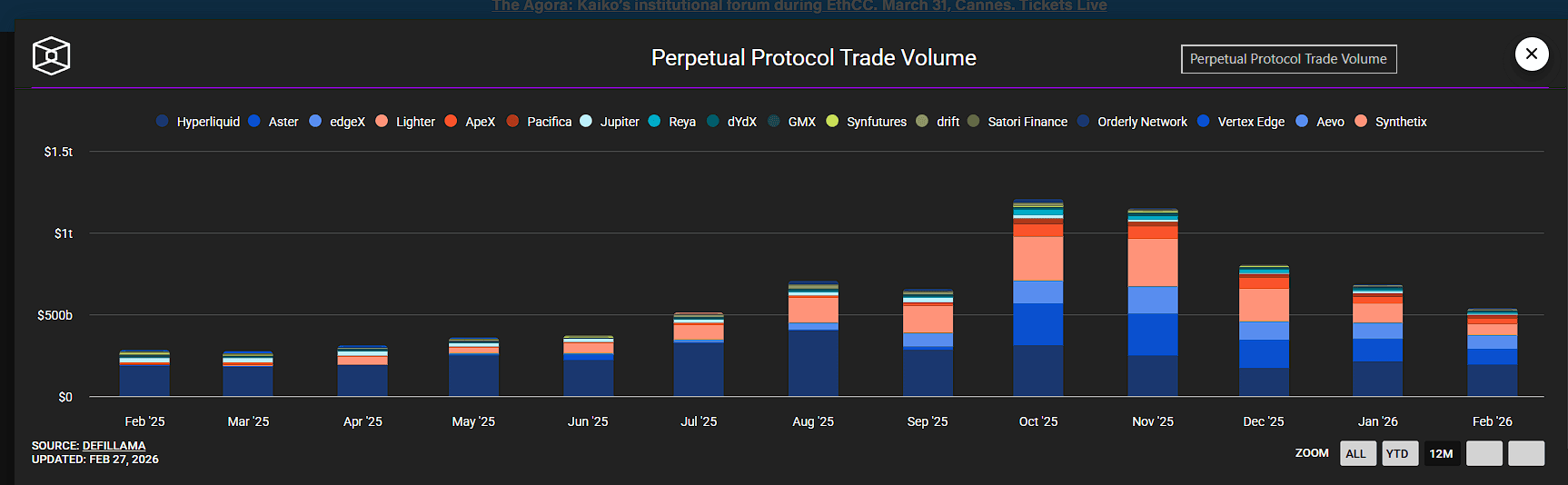
But the revenue model hasn't changed. It's still almost entirely dependent on trading fees, and that creates a problem every PerpDEX founder already feels when markets go quiet.
CEXs running the same products figured out a second layer years ago. Here's what it looks like and why PerpDEXs need it now.
How PerpDEXs Actually Make Money Today
The current revenue model has three sources: trading fees on executed volume, funding rate spreads between longs and shorts, and liquidation fees when positions get closed forcibly.
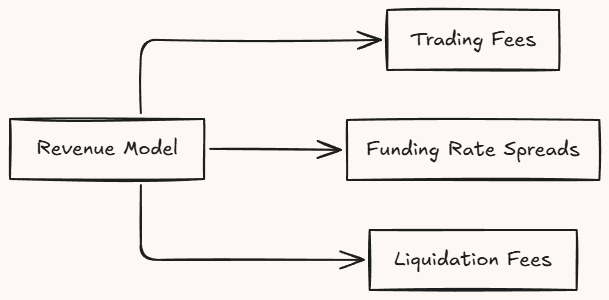
All three are cyclical by nature. In high-volatility periods, volume spikes, funding rates widen, and liquidations happen frequently.
In sideways or low-volatility markets, all three compress simultaneously. A platform doing $1B in daily volume during a volatile week might see $100M on a quiet one.
And when volume drops, there's no floor. The revenue model has no component that earns independently of trading activity, and that's the structural gap lending fills.
What CEXs Built on Top of the Same Trading Model
Binance, OKX, and Bybit all run perpetual futures products. They also all run lending products sitting directly alongside them, and that's not a coincidence.
The same user depositing $50K as margin for a perp position is also a user who wants that capital working when they're not actively trading.
CEXs recognized this early and built products to capture it.
| Exchange | Perp Product | Lending Product | Flexible APR (USDC/USDT) |
|---|---|---|---|
| Binance | Binance Futures | Binance Earn | ~3.9% |
| OKX | OKX Perpetuals | OKX Earn | ~1.7% to 10% |
| Bybit | Bybit Derivatives | Bybit Savings | 2 to 5.8% |
The two products reinforce each other. A trader who earns yield on idle capital has less reason to withdraw between positions.
Capital that stays on-platform deepens liquidity, tightens spreads, and generates more trading activity over time.
Lending doesn't compete with the perp product and makes the perp product even better.
The Idle Capital Problem Every PerpDEX Has Right Now
Most traders on a PerpDEX don't always have positions open. Capital sits idle overnight, between trades, during low-conviction periods, and whenever a trader is waiting for the right setup.
On most PerpDEXs, that idle capital earns exactly 0%.
Consider what that looks like at scale. A platform with $500M in deposited collateral, where 40% sits idle at any given time, has $200M generating nothing.
At 5% APY routed through lending, that's $10M in annual yield available to split between users and the protocol.
At a 10% protocol take rate, that's $1M in new annual revenue from capital that was previously a dead weight on the balance sheet.
For traders, the math is equally straightforward. A trader holding $100K in collateral earning 0% between positions is leaving $5,000 per year on the table compared to a platform that routes idle margin to lending automatically.
That's a retention problem that compounds every day the feature isn't live.
What Lending Unlocks for a PerpDEX Specifically
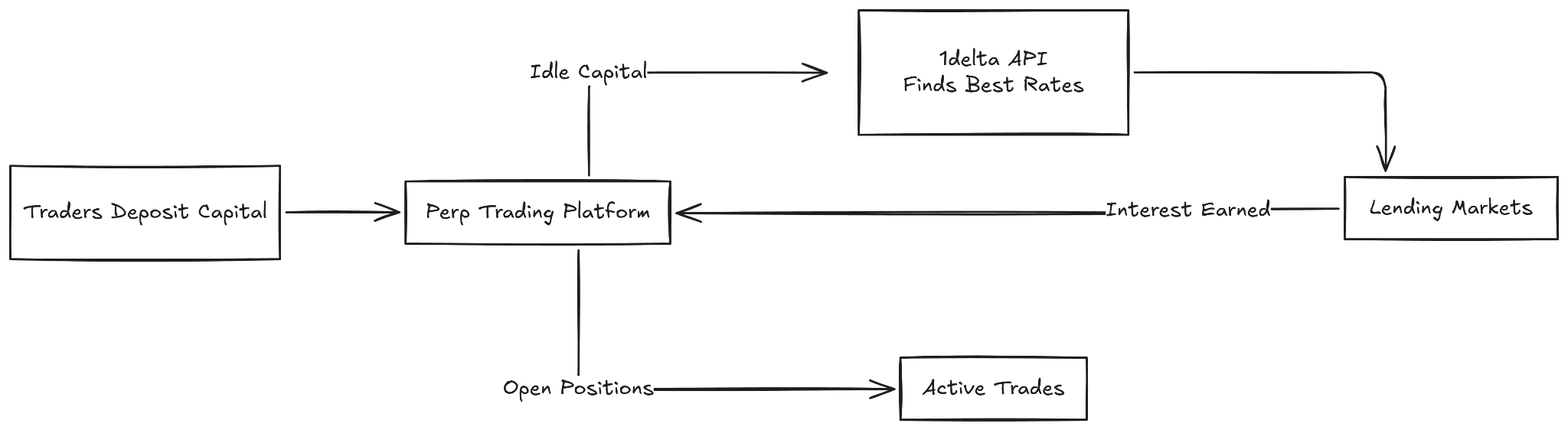
- Idle collateral yield. The most immediate unlock. Capital sitting as margin automatically routes to the best available lending rate and withdraws instantly when a position opens.
Users see a live APY on their balance. The platform earns a protocol cut on every dollar working in the background.
-
Yield-bearing margin. Traders deposit yield-generating assets as collateral. The margin earns its underlying protocol yield while the position is live, meaning the trader is getting paid to hold their position open. hyENA built their model around this mechanic.
-
Borrow against open positions. Traders with profitable positions can borrow against their collateral without closing the trade. This unlocks liquidity without forcing position management, which is a product CEXs offer and most PerpDEXs currently don't.
How to Add Lending Without Rebuilding Your Stack
The infrastructure requirement is real but manageable with the right approach.
Building lending in-house means separate protocol integrations per chain, custom position tracking logic, rate optimization that updates continuously, and ongoing maintenance as protocols upgrade. A realistic in-house timeline is 5 to 6 months before idle yield ships on a single chain.
Most PerpDEX teams should spend that time on their execution layer, liquidation engine, and trading UX.
| Build In-House | 1delta API | |
|---|---|---|
| Protocols | 1 to 3 per chain | 200+ across all chains |
| Chains | Whichever you build for | 50+ out of the box |
| Time to ship | 5 to 6 months | 2 to 6 weeks for basics |
| Maintenance | Your team | Handled |
| Rate optimization | Build your own | Built-in, real-time |
| Atomic execution | Build per protocol | Single deltaCompose call |
| Risk monitoring | Build your own | Normalized, included |
1delta is a unified lending API covering Aave, Compound, Morpho Blue, Init Capital, and 200+ protocols across 40+ chains behind a single integration.
Your team integrates once. Everything else is handled by 1delta.
The Revenue and Retention Case in One Place
PerpDEX volume is the highest it's ever been. The traders are there, the capital is there, and the collateral is already sitting on your platform.
Lending turns that idle capital into a revenue stream that earns regardless of whether markets are moving, and it gives traders a reason to keep their full balance on-platform rather than withdrawing between positions.
CEXs have run this playbook for years. The PerpDEXs that add lending in 2026 will enter the next high-volume cycle with deeper TVL, stronger retention, and a revenue floor that doesn't disappear when volatility does.
If you want to explore what integration looks like for your platform, reach out directly.
Request API access: 1delta.io | Documentation: docs.1delta.io
Contact: Telegram | [email protected]