Here's How DEXs Can Build Better Vault Products In 2026
Most DEX vaults run on trading fees alone. This guide covers four vault types DEXs can build using lending infrastructure: idle yield vaults, delta-neutral vaults, yield-bearing collateral vaults, and looping vaults with up to 10x leverage. Includes build timeline, protocol mapping, and how 1delta reduces integration from 6 months to under 8 weeks.
Most DEX vaults today capture one yield source: trading fees. When volume drops, the vault underperforms. When markets turn, users leave.
The DEXs pulling ahead are running vaults that use lending as a second engine, earning yield on capital that would otherwise sit idle.
Three Lending Vaults DEXs Should Build
1. Idle Yield Vault
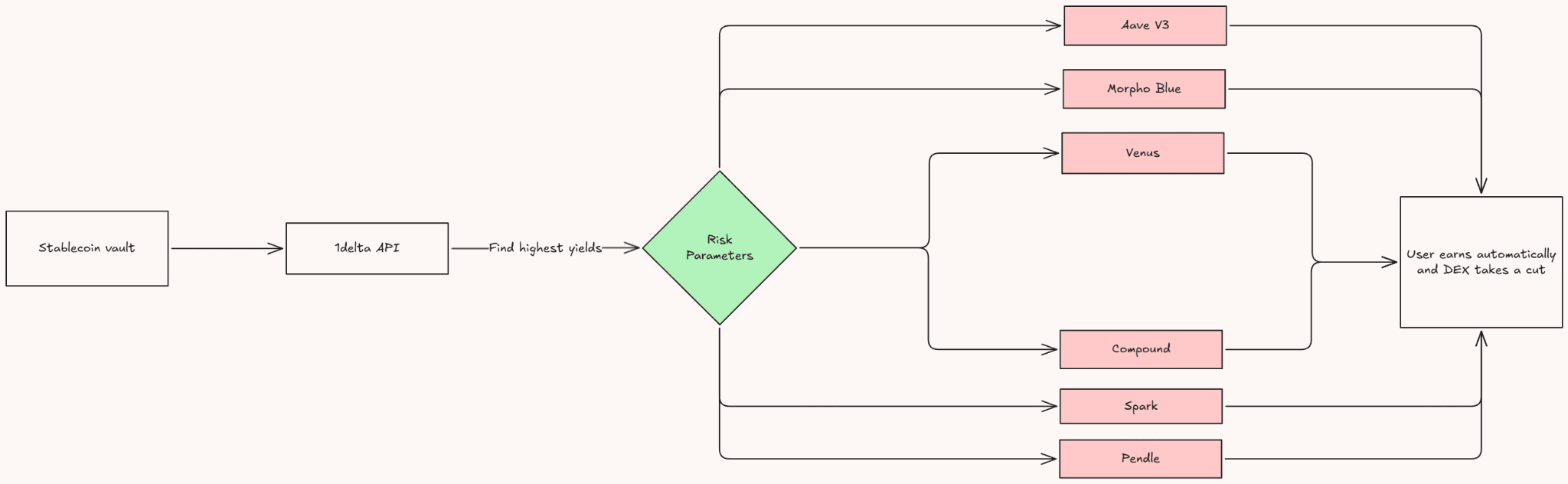
Capital inside a DEX that isn't actively trading earns nothing by default. This vault routes that idle capital to the highest-yielding lending protocol automatically and withdraws instantly when the user wants to trade.
Users see a live APY on their balance. The DEX takes 10-20% of yield as protocol revenue. On $200M in idle deposits at 5% APY, that's $1-2M in annual revenue from capital that was previously generating zero.
2. Delta-Neutral Yield Vault
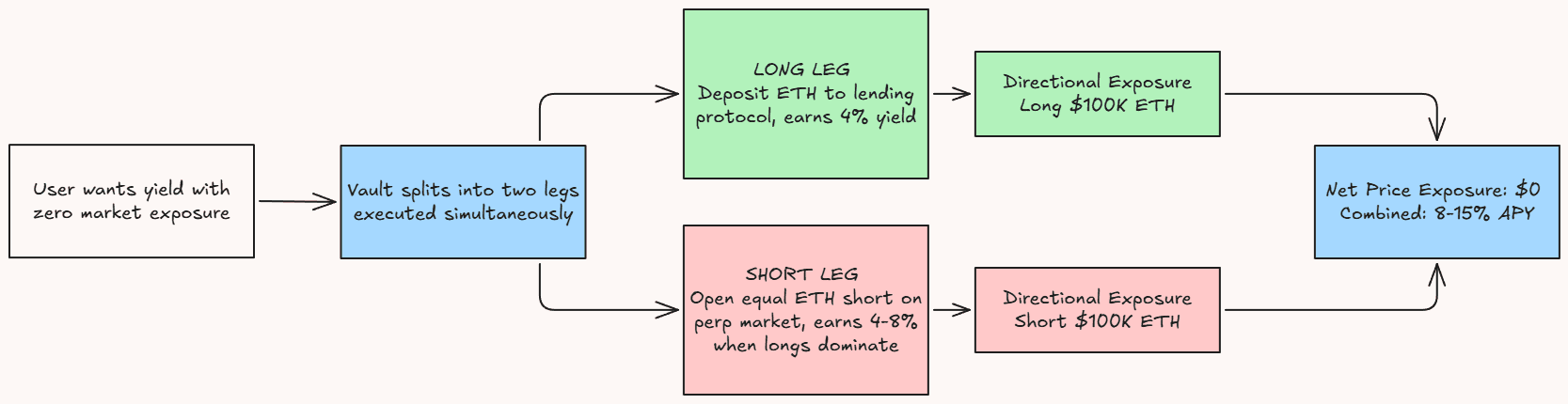
The vault opens a long on a spot asset via lending and an equal short via a perp simultaneously. The directional exposure cancels out.
What remains is lending yield on the long side plus funding rate capture on the short side.
In periods of elevated long demand, well-constructed delta-neutral vaults return 8 to 15% APY with no net price exposure.
The users it attracts are experienced allocators who want yield without a market bet, typically the largest balances on any platform.
3. Looping / Yield Amplification Vault
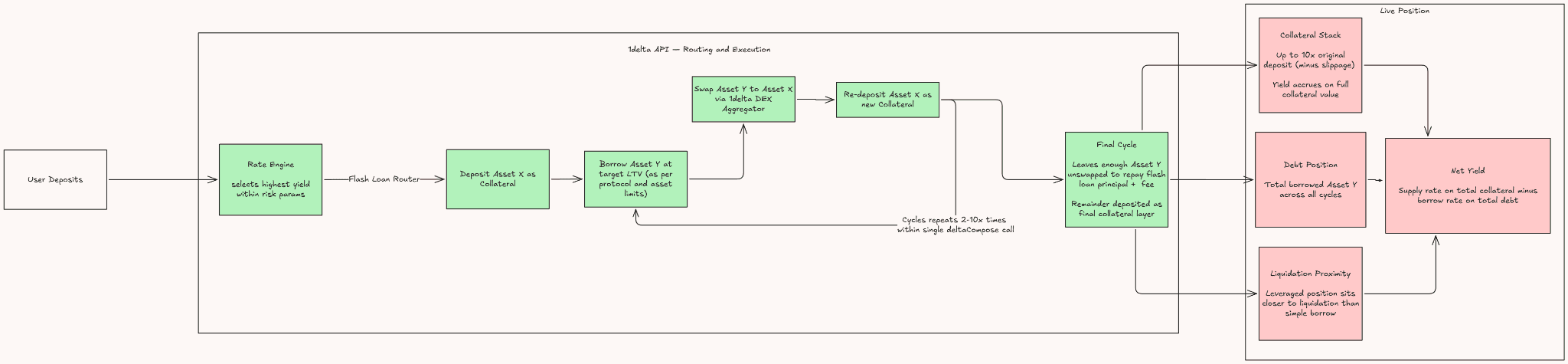
The vault supplies a user deposit to a lending protocol, borrows against it, swaps the borrowed asset back, and re-deposits it as collateral.
This repeats atomically across 10 cycles until the target leverage is reached, all within a single deltaCompose transaction.
The result is up to 10x amplified exposure on the original deposit, with net yield determined by the supply rate on the total collateral stack minus the borrow rate on accumulated debt.
A user depositing $10K into a vault earning 5% base APY, borrowing at 2.5%, reaches an effective collateral stack of roughly $28K at 3x or up to $90K at 10x.
Net yield scales with leverage but so does liquidation proximity and borrow rate sensitivity.
CEX vs. DEX Vaults (And How To Build One)
CEX earn is custodial. Users hand capital to the exchange with no visibility into where it's deployed or what risk is being taken.
Every vault above is on-chain. Users can verify their position, the underlying protocol, current rates, and liquidation parameters at any time.
What 1delta Provides for Each Vault
Building the lending layer in-house means separate integrations per protocol per chain, custom rate optimization logic, and ongoing maintenance as protocols upgrade. Three protocols across four chains is 5 to 6 months before the first vault ships.
1delta is a unified lending API covering 200+ protocols across 50+ chains behind a single integration.
Each vault maps directly to what it provides:
| Vault | What 1delta Handles |
|---|---|
| Idle yield | Real-time rate comparison, auto-routing, instant withdrawal |
| Delta-neutral | Unified position tracking, normalized risk metrics, rate monitoring |
| Looping Vault | deltaCompose executes the full loop atomically in one transaction |
With 1delta API, you can build a basic vault in less than a week.
Start Building Vaults
Most DEX run the same way. Building lending vaults add a second revenue source as well as creates a better UX for users.
The capital to fill these vaults is already on your platform or one product decision away. If you want to explore what integration looks like for your DEX, reach out directly.
API access: 1delta.io | Docs: docs.1delta.io | Contact: Telegram or [email protected]