How CEXs Are Integrating DeFi Lending to Launch Earn Products
Learn how centralized exchanges are integrating Aave and Morpho to offer yields that internal desks cannot match, and how 1delta lets you ship the same product in weeks.
Coinbase, Kraken, Crypto.com, Bitget, Bitpanda, and even Société Générale, a regulated bank, have now integrated DeFi to run their earn products, with their own branded UX on top.
The infrastructure running underneath these products, Aave and Morpho, hold a combined $33B in TVL, $20B in active borrowings, and generate over $1B in annualized fees paid to lenders.
But none of the CEX users interacted with a smart contract or knew the backend was on-chain, and here's how you can do it too.
DeFi Earn vs. Internal Earn: Why the Yield Gap Is Permanent
If you set borrowing rates too high and you kill borrower demand, which shrinks the yield pool you have to distribute. Set them too low and lender yields suffer, which kills the earn product's competitiveness.
On-chain lending protocols remove you from that equation entirely.
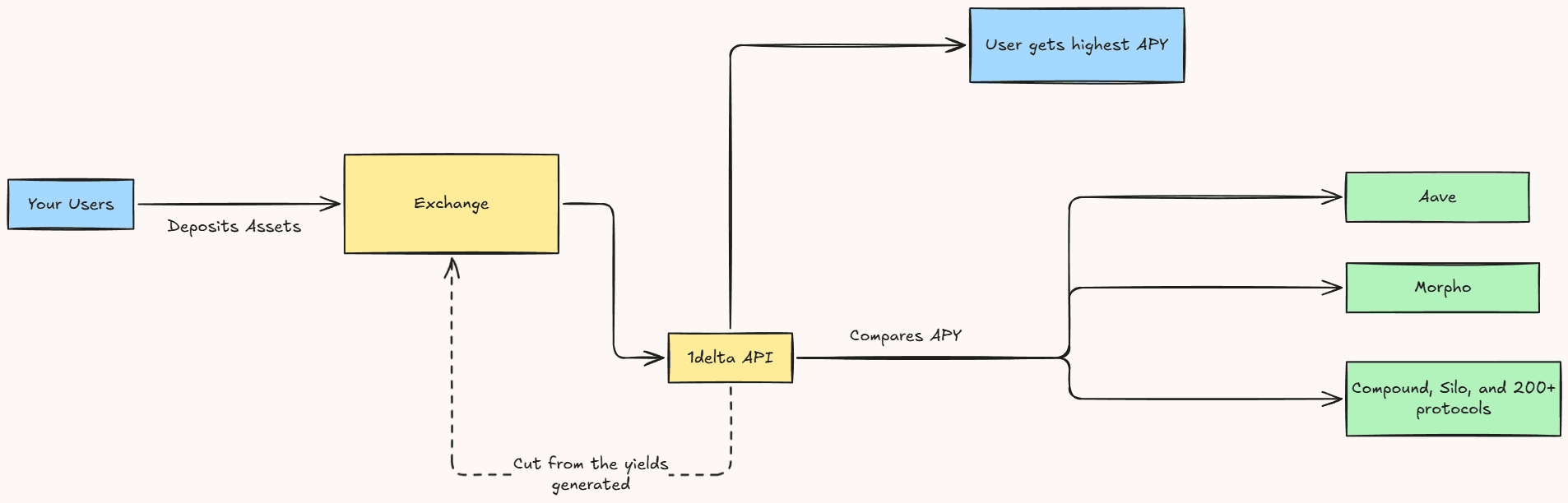
Borrowing rates adjust automatically to utilization: when demand rises, rates rise, lenders capture more, and the protocol rebalances without intervention.
You still take a cut of the yield before passing it to users. The difference is that the rate your users see is now determined by actual market demand.
For example, Binance offers 2–5% on USDC from their internal desk. Right now, Morpho vaults are offering up to 13–15% APY on the same asset. Your users can see both numbers.
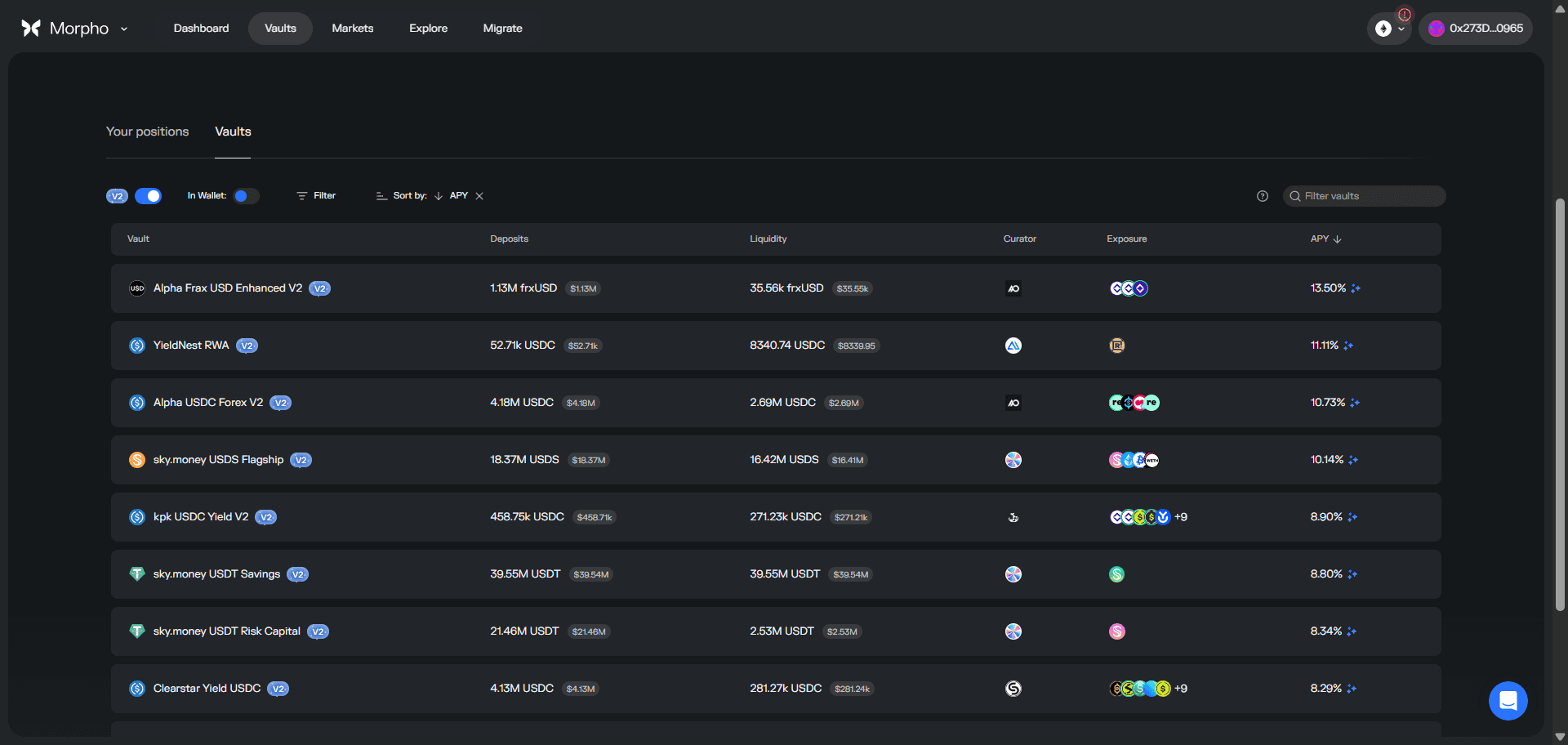
As institutional borrowing demand routes increasingly on-chain, protocol rates continue pulling away from internal desk rates.
A user comparing two exchanges with equally smooth interfaces will move to the one paying 15% over 2%.
The DeFi Earn Checklist No One Talks About
Every exchange that has tried to build this in-house found out the same thing: launching a DeFi earn product is a multi-team, multi-month process.
Here is what is actually on your plate before a single user earns their first dollar.
Engineering:
- Wallet and gas abstraction so users never touch a smart contract
- Deposit routing between your exchange accounts and on-chain protocol vaults
- Position tracking across protocols, normalized into your earn UI in real time
- Rate monitoring, error handling, and fallback logic for edge cases
Compliance:
- Custody classification: are user funds in your custody when deployed to a vault?
- Securities treatment of yield, which varies by jurisdiction
- KYC and AML coverage for on-chain activity
- Separate legal sign-off for every market you operate in
Timeline:
- Months 1 to 3: architecture decisions and protocol selection
- Months 4 to 8: core integration build
- Months 9 to 12: compliance review and jurisdiction sign-off
- Months 12 to 18: audit, testing, and soft launch
Most exchanges that have tried this in-house report 12 to 18 months before anything ships. Your competitors did not wait that long.
Integrate Earn Products In Your Exchange
The checklist above is real. The compliance work, the jurisdiction reviews, etc., none of that disappears. But the build time and engineering effort does.
1delta is a unified lending API across 200+ protocols including Aave, Compound, Morpho Blue, Silo, and Init Capital, on 50+ chains, behind a single integration point.
Compliance is your team's responsibility. We make it easy for your engineering and product teams to deploy a working earn product faster with:
- Rate optimization: runs across the full protocol landscape in real time
- Position tracking:normalized across all integrated protocols
- Fast Execution: atomic through a single call
- Full protocol and chain coverage documented at docs.1delta.io
Request API access at 1delta.io or view technical documentation at docs.1delta.io.
Contact: Telegram or [email protected]