How to Add DeFi Lending to OpenClaw Agents (Safely)
Add DeFi lending to OpenClaw agents without building protocol integrations. Enable safe, approval-based yield on idle stablecoins across 200+ lending protocols and 50+ chains via 1delta.
OpenClaw agents can manage your emails, control your smart home, and automate workflows across dozens of apps.
But they still cannot do the simplest financial automation: earning yield on idle stablecoins.
They cannot take your USDC savings and lend it safely, monitor yield positions, or rebalance when rates change, without you manually checking DeFi dashboards.
This needs to change. This guide shows how to add DeFi lending to OpenClaw without building and maintaining protocol integrations from scratch.
Why DeFi Lending Matters for Personal Agents (Not Traders)
If you are building an OpenClaw agent, the user is not a trader. They are a normal person who holds stablecoins for:
- savings
- payments
- buffers
"I don't want to be fully in crypto, but I want to earn dollars onchain"
Three reasons lending matters for personal agents.
Idle stablecoins are dead money
Most people hold USDC or USDT in wallets between purchases or as savings, which earns 0%.
The same stablecoins lent to established protocols like Aave or Morpho can earn 4% to 8% APY depending on market conditions.
On $10K, that is $400 to $800 per year left on the table.
Humans don't want to manage yields.
The barrier is not intelligence, but rather friction.
People do not:
- check rates weekly
- compare protocols
- move funds across chains
- rebalance when it is worth the gas
Personal agents can do this reliably because monitoring is what they are best at.
Personal agents need conservative, passive strategies
Unlike trading bots that chase alpha, personal finance agents should focus on:
- stable yield
- established venues
- minimal moving parts
- explicit user control
Lending fits this perfectly.
The gap is doing it safely, so your agent cannot lose money through bad decisions or confusing UX.
Who Actually Wants This in OpenClaw
You are not building for degens. You are building for three types of consumer users:
- Conservative savers: People with $5K to $50K in stablecoins who want passive yield without managing DeFi. The agent lends idle USDC to the best available venue among a whitelist. It never borrows. It never uses leverage.
- Set-and-forget accumulators: People who deposit stablecoins regularly and want compounding without manual intervention. The agent detects incoming transfers, waits until the amount is large enough to justify gas, then deploys to a lending market.
- Multi-wallet holders: People who have stablecoins across multiple wallets and chains. The agent tracks balances, recommends consolidations when gas is low, and maintains a simple allocation across yield sources.
If your user fits any of these, an OpenClaw agent with lending capability makes their money work while they focus on everything else.
What a DeFi Lending Skill for OpenClaw Actually Does
OpenClaw uses skills to extend agent capabilities. A DeFi lending skill gives your agent a small set of actions:
- check stablecoin balances
- query lending rates
- propose a lending action
- construct an unsigned transaction
- monitor the position and suggest rebalancing
The key difference versus trading agents is simple:
In OpenClaw, the approval UX is the strategy.
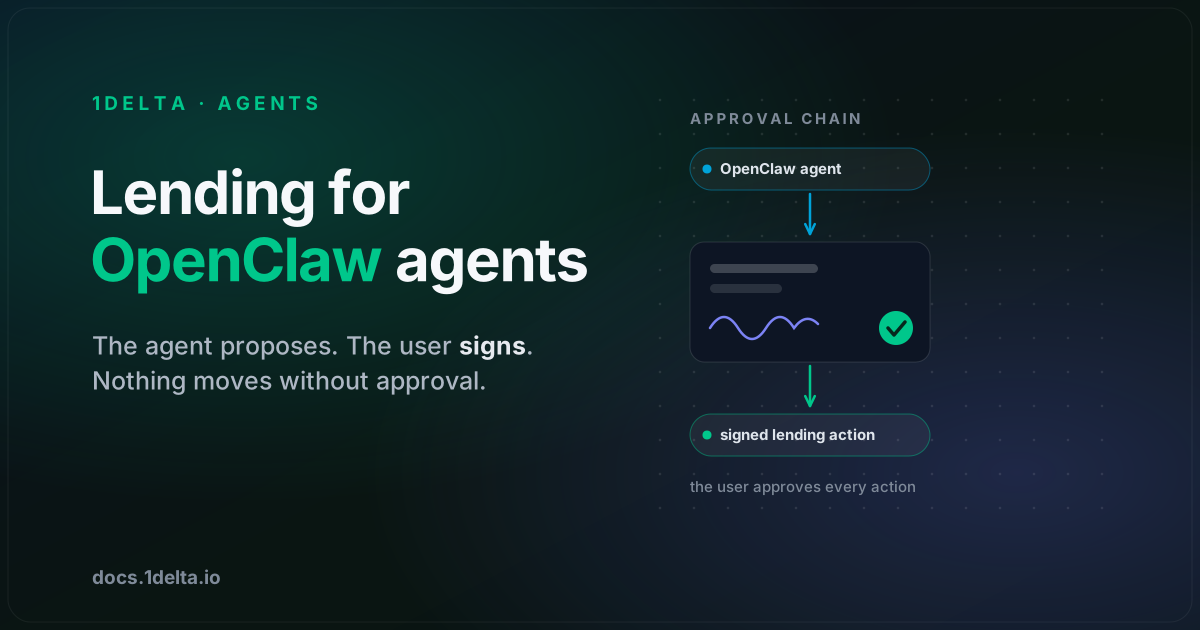
Here is what a real flow looks like:
- The agent detects idle capital. Example: you have $8,000 USDC that has not moved in 30 days based on your configured idle threshold.
- The skill queries current rates. It checks supply APY across Aave, Morpho, and Compound on the chain where your USDC sits.
- The agent proposes an action. It formats a clear approval request:
"You have $8,000 idle USDC earning 0%. I can lend it to Morpho earning 6.2% APY. Estimated annual yield: $496. Estimated gas cost: $12. Approve?"
- You approve or reject. No autonomous money movement without explicit confirmation.
- The skill handles execution. It constructs the transaction, simulates it, and executes only after you sign.
- The agent monitors ongoing. It tracks yield and proposes rebalancing only when the net benefit exceeds gas costs.
This is how consumer DeFi should work: simple, conservative, and permissioned.
The OpenClaw Skill Architecture That Makes This Safe
This is the part most teams underestimate.
A personal agent is not allowed to "just execute." It needs a safety model that is built into the skill itself.
Skill manifest and permissions
The skill declares what it can do:
- read wallet balances
- fetch rate data
- request a transaction signature
- monitor positions
- propose rebalancing
Users grant permissions explicitly. The skill cannot access anything it did not request.
-
Rate discovery and comparison: The skill fetches supply APY across protocols and normalizes it into comparable formats so the agent can rank options.
-
Transaction construction: The skill builds unsigned transactions for each action. Supply encodes the protocol deposit call. Withdrawals handle protocol-specific withdrawal mechanics.
-
Safety constraints and limits: Before proposing any action, the skill validates against conservative rules:
- max position size
- protocol whitelist
- rate sanity checks
- gas cost thresholds
- rebalancing only when net benefit is positive
-
Position tracking and alerts: The skill tracks where capital is deployed, how much interest has accrued, and when conditions justify a move.
This is what turns "DeFi access" into "personal finance automation."
Add DeFi Lending to OpenClaw With One API
If you integrate Aave, Morpho, and Compound directly, you have to build and maintain a protocol adapter suite, across chains, forever.
The integration can be way smoother if you build one OpenClaw skill that calls a unified lending API.
1delta aggregates 200+ lending protocols across 50+ chains into a single interface. Your OpenClaw skill calls one API for lending operations instead of maintaining integrations protocol by protocol.
With one API, your skill can:
- query normalized rates across protocols and chains
- construct transactions through a single transaction builder
- simulate and validate actions against constraints
- fetch unified position data across supported markets
- propose rebalances with gas-aware recommendations
Instead of hardcoding protocol logic, your OpenClaw skill becomes a safety and UX layer on top of lending execution.
Ship a Consumer Yield AI Agent With Controls
If you are building OpenClaw agents, DeFi lending is the first financial primitive that maps cleanly to personal automation.
A single OpenClaw skill that wraps 1delta gives you:
- lending across 200+ protocols and 50+ chains
- conservative execution with user approvals
- normalized data for rate comparisons
- simulation-driven validation before signing
- unified position tracking across protocols and chains
- gas-aware rebalancing recommendations
Request API access at 1delta.io or view technical documentation at docs.1delta.io. Contact: Telegram | [email protected]