How to Add DeFi Lending to LangChain Agents
Add DeFi lending to LangChain agents without building protocol adapters. Enable supply, borrow, repay, withdraw, looping, and position tracking across 200+ lending protocols on 50+ chains via 1delta.
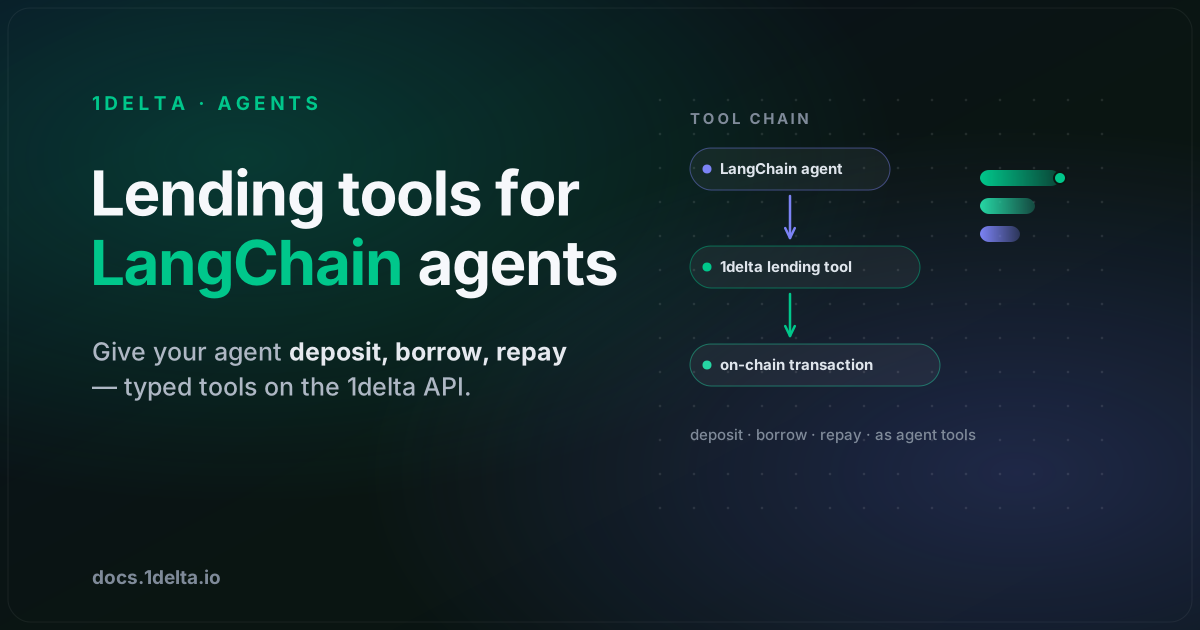
LangChain agents can search, summarize, and orchestrate workflows across your stack,
but they still cannot execute the most important financial workflow: deploying capital onchain.
They cannot supply stablecoins to earn yield. They cannot borrow against collateral. They cannot manage lending positions as part of a larger strategy.
This is the execution gap.
And DeFi lending is the first primitive that closes it.
This guide shows how to add DeFi lending to LangChain agents without building and maintaining protocol integrations from scratch.
Why LangChain Agents Need DeFi Lending Access
If you are building agents for financial workflows, treasury management, or yield automation, recommendations are not enough. Your agent needs to execute.
Three reasons lending matters:
-
Manual execution breaks the workflow. When your agent identifies a 7% yield opportunity but requires a human to click "deposit" every time, the agent becomes a dashboard with extra steps.
-
Lending maps cleanly to LangChain tools. DeFi lending is deterministic. Supply, borrow, withdraw, and repay are smart contract calls with clear inputs and outputs. This fits LangChain's tool-calling model directly.
-
Lending is the gateway to more advanced execution. Once an agent can lend, it can also do collateral-backed borrowing, idle capital optimization, looping, and multi-step strategy execution.
The gap is not whether LangChain agents should access DeFi lending. The gap is how quickly you can ship it without owning protocol complexity forever.
What Products This Enables (Not Just "Agent Types")
Most LangChain teams are not building standalone bots. They are shipping features inside products.
DeFi lending unlocks a new class of product capabilities:
-
Earn and yield accounts inside fintech apps: Let users deposit stablecoins and earn yield automatically, with the agent routing capital across lending markets and rebalancing when rates shift.
-
Treasury automation for DAOs and protocols: Idle capital is expensive. A LangChain agent can monitor balances, deploy when thresholds are met, and withdraw when liquidity is needed.
-
Wallet and exchange "Earn" experiences: Add lending as a native capability: supply, withdraw, and track positions, without forcing users to leave your product.
-
Collateral-backed execution for trading and funds: Supply ETH as collateral, borrow stablecoins, deploy into strategies, and manage risk thresholds programmatically.
If you are building any of these, lending is not an optional integration. It becomes part of your execution layer.
What a DeFi Lending Tool for LangChain Actually Does
A LangChain tool for DeFi lending translates intent into onchain execution.
A typical user request looks like this: "Supply 1,000 USDC on Base to earn yield."
Your LangChain system needs to do five things reliably:
-
Parse the intent Action: supply Asset: USDC Amount: 1,000 Chain: Base Protocol: optional (Aave, Morpho, Compound)
-
Fetch market data Supply APY, liquidity, utilization, and any protocol constraints.
-
Build the transaction Correct contract, correct calldata, correct approval flow.
-
Simulate before execution Reduce revert risk and surface warnings before signing.
-
Return a structured response An unsigned transaction (or calldata), expected rates, estimated gas, and any constraints.
Your agent handles decision logic. The tool handles execution mechanics.
This separation is the difference between a prototype and something you can ship.
The LangChain Problem Most Teams Miss: State, Not Transactions
LangChain agents are often stateless between runs. Lending positions are not.
Once a user supplies collateral or borrows assets, your product needs persistent state:
- supplied balance + accrued interest
- borrowed balance + accrued interest
- current collateral and debt composition
- risk parameters and liquidation thresholds
- position health over time
If you do not solve state and accounting, you will ship an agent that can "deposit once," but cannot manage positions as a real system.
This is why DeFi lending is not just a transaction integration. It is an execution and state layer.
How to Ship DeFi Lending in LangChain Without Overbuilding
You do not need to support every protocol and chain on day one. You need a narrow, reliable v1.
A practical rollout:
-
Start with the chain your users already hold capital on. Your first job is to make supply, withdraw, borrow, and repay reliable on the primary chain.
-
Support 2 to 3 major venues first. This gives you real rate selection without exploding integration scope.
-
Make routing rules explicit. Examples:
- "use the highest supply APY"
- "use the lowest borrow APR"
- "prefer Morpho if within 0.5% of best rate"
-
Treat safety as part of v1. If your agent can move capital, you need position caps, protocol whitelists, and emergency stops from day one.
-
Expand chains only when usage demands it. Do not build surface area you cannot monitor.
This is how you ship lending as a product capability.
Add DeFi Lending to LangChain With One API
If you integrate protocols directly, you are signing up to maintain protocol adapters forever.
Each protocol has different contract interfaces, deployment addresses, risk models, and edge cases. Then you multiply by chains.
The integration collapses if you build your LangChain tool against a unified lending API.
1delta aggregates 200+ lending protocols across 50+ chains into a single interface. Your LangChain tool calls one API for all lending operations.
Non-custodial architecture means funds remain in the user or agent smart wallet. 1delta returns unsigned transactions or calldata that your signer validates and executes.
Instead of building separate tools for Aave, Morpho, Compound, and dozens of others, you build one tool that:
- queries rates across protocols using normalized data
- constructs transactions through a single transaction builder
- returns consistent outputs regardless of protocol or chain
- lets your agent stay focused on reasoning and policy
What you get from the unified interface
-
Normalized market data: Borrow rates, collateral factors, and risk parameters come back in consistent formats. Your agent can compare markets without writing protocol-specific translation layers.
-
Atomic multi-step execution: Supply and borrow can be executed as a single transaction. More complex operations like looping and migrations can also execute atomically in many cases. 1delta uses flash loans internally to reduce partial execution risk.
-
Safety validation via simulation: Transactions can be simulated and checked against configured constraints before execution, including protocol limits and position thresholds.
-
Multi-chain coverage without infrastructure overhead: The API routes to the correct chain. Your LangChain system does not need to manage RPC failover or chain-specific execution plumbing.
-
Unified position view: Instead of building separate accounting logic for every protocol, your tool can query a unified position endpoint for supplied assets and debt across supported markets.
Ship DeFi Lending Actions in LangChain (Supply, Borrow, Repay, Withdraw)
If you are building LangChain agents for finance, this is the fastest path to move from analysis to execution.
A single LangChain tool that wraps 1delta gives you:
- DeFi lending access across 200+ protocols and 50+ chains
- standardized data formats for routing and risk decisions
- atomic execution for multi-step lending actions
- simulation-driven safety checks before signing
- unified position tracking for ongoing state and accounting
This is the difference between:
"Our agent suggests yield." And: "Our agent deploys and manages yield."
Request API access at 1delta.io or view technical documentation at docs.1delta.io. Contact: Telegram | [email protected]