Weekly Brief: 3.60% on-chain, 3.88% at the Fed
The Fed hiked to 3.75–4.00% today, the first rise since 2023, and Aave pays 3.60% on USDC. Circle's Arc went to mainnet the same afternoon with $334M of day-one TVL, 91% of it lending, and ten different tokens called ARC. CLARITY failed 49–50. Plus cirBTC's 5x week and Liquid's restart.

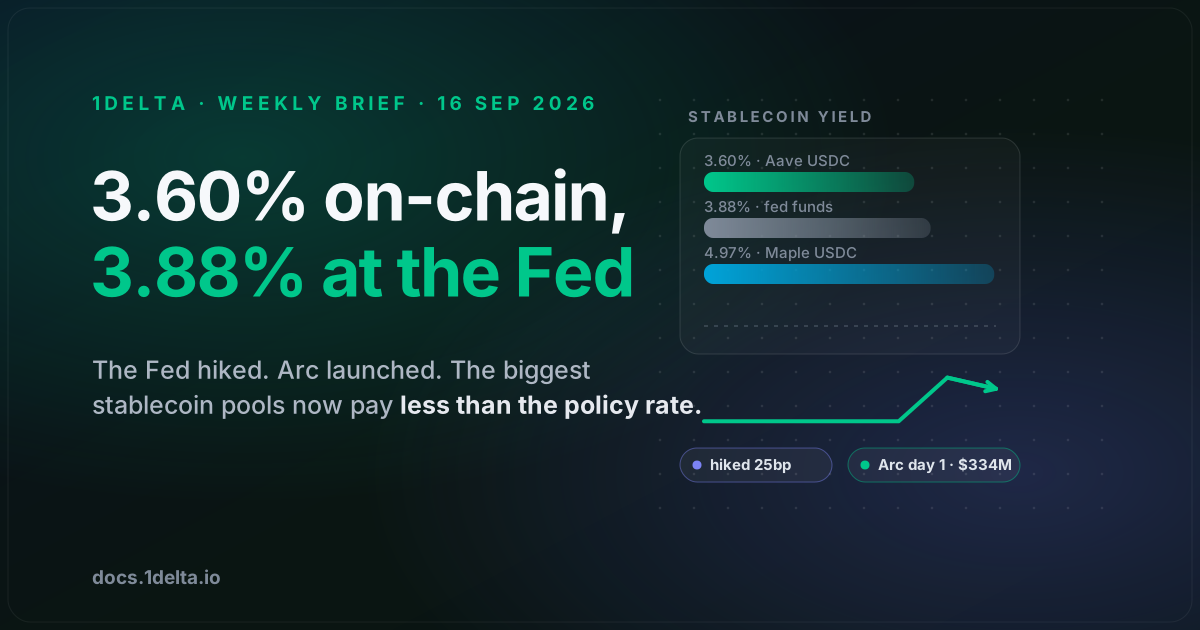
This brief is a day late, and the day mattered. The Fed raised rates by 25 basis points this afternoon to a 3.75–4.00% target, 12–0, the first increase since 2023. Circle's Arc chain went to mainnet a few hours earlier. And last night the Senate voted 49–50 against taking up the CLARITY Act, which ends market-structure legislation for the year.
No lending protocol was exploited this week - the first time we can write that since this brief started - so the yield numbers get the room. Aave V3 pays 3.60% on USDC this evening. Sky pays 3.60% on sUSDS. Between them those two hold more than nine billion dollars of stablecoins, and as of today both pay less than the Fed.
Everything below is current as of 16 September 2026, 20:30 UTC. Aave rates are read from the pool contract; the rest of the yield table is from DefiLlama.
Where the yield is
Read the chart left to right and it sorts itself. The two largest pools - Sky's sUSDS at $4.62B and Aave's USDC market - both end at 3.60%, 28 basis points under the new fed funds midpoint. Aave USDT is 73 under it. Those are the venues with no counterparty beyond a smart contract and no curator, and their rate is set by one thing: how much borrowers are willing to pay. On Aave that number is 4.32% for USDC, and after the protocol's reserve factor it leaves suppliers 3.60%.
Everything to the right of the line has a reason to be there. Maple pays 4.97% on USDC and 4.62% on USDT because it lends to named institutional borrowers against off-chain collateral, which is credit risk of a kind Aave does not carry. The Morpho vaults on Base pay 4.28% because a curator - Steakhouse, Gauntlet - picks which isolated markets to supply into, and takes a fee for it. Sky's stUSDS pays 5.11% on a $205M pool that is a fraction of sUSDS.
Then there is what the table leaves out. DefiLlama shows several pools above 5%, and every one of them is rewards on top of base: Morpho's Steakhouse USDG vault on Robinhood Chain reads 7.03% total against 3.67% base, Sirloin USDC on Base 5.62% against 2.83%. Aave's USDe market shows 4.75% with a base of 0.66%. That gap is token emissions, and emissions are somebody's marketing budget rather than somebody's interest payment.
So the clean statement of where on-chain dollar yield stands after today: the risk-free benchmark on chain is below the risk-free rate off chain, and the premium above it is being paid for credit risk, curation, or in tokens. Sixteen of eighteen FOMC participants expect another hike this year, which would widen the gap to half a point.
Six weeks of Aave, read from the pool
We pulled getReserveData for USDC, USDT and WETH on Aave V3 Ethereum at five points since August. Supply and variable borrow APR:
Six weeks, and the USDC borrow rate has moved 34 basis points. WETH has not moved at all. That is what a lending market looks like when nobody is levering up: rates sit at the flat part of the interest-rate curve and stay there. The Fed can raise its rate tomorrow and none of these numbers will respond, because none of them are priced off it. They are priced off utilisation, and utilisation is priced off how much leverage people want.
The week-on-week move in USDT - 3.60% down to 3.15% - has a specific cause, and it is on the supply side. We read the aToken and debt-token supplies on Ethereum a week apart: USDT supplied went from $2,986M to $3,158M (+5.8%) while USDT borrowed went from $2,777M to $2,753M (−0.9%). USDC supplied rose 3.6% against borrows up 1.7%. More lenders, the same borrowers, lower rate. Stablecoins were still arriving at Aave at 3.5% in the week the Fed moved to pay more for them.
What that means for anyone allocating stablecoins: the choice this month is between Aave at 3.60% with a smart contract as the only counterparty, Maple at 4.97% with a borrower's balance sheet as the counterparty, or a curated vault in between. Every option that beats a Treasury bill has a name attached to the risk. The one without a name attached now pays less than the bill, and so far its depositors have not moved.
Arc: day one was a lending day
Circle's Arc L1 went to public mainnet this afternoon. The founding validator cohort is Circle plus eleven institutions - BlackRock, DTCC, Galaxy, Global Payments, ICE, Mastercard, MoneyGram, SBI, Standard Chartered, Sumitomo and Visa - the full 10 billion ARC supply was minted at genesis (Circle says that is not a commitment to launch the token publicly), and more than a hundred applications were live on day one. Aave's Arc market lists cirBTC as a launch asset alongside USDC, EURC and WETH. The pitch is payments and settlement for institutions. At 20:30 UTC on launch day, our DefiLlama snapshot showed $333.7M of Arc TVL, and $303.5M of it was in two lending protocols.
Arc is the first chain where Aave exists only as V4. We checked rather than assumed: DefiLlama lists Aave V3 on 21 chains and Arc is not among them, while V4 is on three - Ethereum at $382M, Avalanche at $15M, Arc at $77.4M. On both of the others V4 sits next to a V3 instance; on Arc there is no V3 to migrate from. The market launched with Bitwise, Cumberland, Dialectic, Galaxy, Gauntlet, Keyrock and Steakhouse supplying curated vault strategies and USDC and EURC liquidity. Against a V4 total of $474M in the same snapshot, Arc's $77.4M is the second-largest V4 market and 16% of the whole.
Morpho took almost three times that. $226.1M on day one is more than Morpho holds on most chains it has been on for a year, and it arrived through markets with independent utilisation curves, so a run on one does not reprice the rest.
The memecoin side showed up too. Our DexScreener snapshot the same evening had the ten most-traded pairs on Arc as ten separately issued tokens all using the ticker ARC, each paired with USDC on Uniswap, each with $10k to $42k of liquidity, together doing about $2.9M of volume on $189k of liquidity in the first day. That is a snapshot of launch-evening trading, not a durable measure. Set against $303M in two lenders, the launch had a clear shape: most of the measured capital was in lending, and most of the trading was in tokens that spoof the chain's own.
Whether the $303M is still there in a month is the number to watch. Launch-day lending TVL is often incentive capital that leaves when the incentives do, and as of this snapshot we found no published Arc incentive schedule from either Aave or Morpho.
Lending by the numbers
Category TVL is $50.26B, flat on the week. Underneath, the money moved.
No lending protocol of size launched this week. Spark's combined Borrow app, which folds SparkLend and its Morpho-based isolated markets into one interface, shipped in late August; Pendle's first market on Robinhood Chain went live on 4 September. The growth this week is Spark taking $412M and Aave taking $254M of stablecoins on Ethereum alone - both at rates the Fed is about to beat.
Follow-ups
cirBTC found its buyers. Last week we bisected Circle's wrapped bitcoin contract and found the supply had sat at 40.02 BTC for five weeks, and said the number to watch was whether Liquid's failure moved it. It moved. Supply was 40.02 through 11 September, read 258.02 on 12 September, settled to 190.02, and is 198.59 cirBTC as we write - about $15.0M at $75,749. A five-fold week, and the first evidence that a trust-bank custody model gets paid for after a federation model fails in public.
Liquid is back, and the bug has a name. Block production resumed on 10 September after functionaries deployed Elements v23.3.4, released the day before. The vulnerability was in how Liquid nodes cache range-proof verifications: the cache keys were not specific enough, so a proof could be marked valid once and then honoured for something it did not prove, which is how roughly 4,000 L-BTC came into existence without Bitcoin behind it. Liquid's incident report puts the first bad L-BTC at Liquid block 4,050,336, 15:53:10 UTC on 6 September, two and a half hours before the peg-out we decoded last week. The tip is current this evening - block 4,058,828 - though transactions and peg operations stayed suspended after the restart pending stability.
The party that took the coins still holds 598.50433547 BTC. The federation address holds 3,601.47. Adam Back has said Blockstream will cover the L-BTC peg shortfall, which is the difference between L-BTC holders being made whole and not.
Aave V4 keeps compounding. DefiLlama TVL is $393.6M, up from $356.6M last week and $226M on 19 August - 74% in under a month on a deployment that has not yet been through a stress week.
The aggregates are flat. Lending TVL reads $50.24B against $50.11B a week ago. Stablecoin supply is $310.29B, down $170M on the week; the rise we noted a fortnight ago has stalled.
What we are watching
- Whether stablecoins keep arriving at Aave below the policy rate. Supply grew $254M on Ethereum in the week before the hike. The gap is now 28 basis points on USDC and, if the FOMC's own projections hold, half a point by December.
- Arc's $303M. Two lenders, one day, no published incentive schedule. The test is October.
- What happens to CLARITY now. The bill would have split oversight of digital assets between the SEC and the CFTC - securities to one, commodities to the other, with a path for tokens to move between them - and it failed 49–50 on the ethics language covering officials' crypto holdings, not on that framework. The seven Democrats who negotiated the text all voted no. The SEC's Regulation Crypto Assets proposal, with its 20 October comment deadline, is now the only market-structure process moving.
- The 598.5 BTC. Blockstream's public bounty was 98. Nothing has moved since the 3,400 came back on 7 September.
- Tomorrow, 17 September. Pendle's first market on Robinhood Chain, sNET, matures - the first maturity on that chain and a small test of whether the fixed-yield leg settles cleanly on a two-month-old L2.
- Whether cirBTC holds 199. A step from 40 to 258 and back to 190 inside four days reads like one or two allocators rather than a flow. The number that matters is whether it is still there in October.
Sources: Aave V3 Ethereum rates read by us from the pool contract 0x87870Bca… via getReserveData at the stated blocks; the remaining yield table from the DefiLlama yields API, base APY only. The Fed decision from CNBC and Yahoo Finance; the prior effective rate from Kiplinger. Arc's launch, validators and day-one integrations from Circle and The Block; Aave V4 on Arc from the Aave governance ARFC; the founding validator cohort from Circle's August announcement; Arc per-protocol TVL, and the Aave V3 chain list and Aave V4 per-chain figures used to establish that Arc is V4-only, from the DefiLlama API at 20:30 UTC on 16 September; Arc DEX pairs from DexScreener at the same time. The CLARITY result from The Crypto Times and CoinGape. cirBTC supply bisected by us on Ethereum at 0x72DFB2E4…; BTC price from CoinGecko. Liquid's restart, the Elements v23.3.4 release and the range-proof cache description from Liquid's incident report, Cointelegraph and The Crypto Times; balances and the Liquid tip read by us from Bitcoin and Liquid mainnet. Lending TVL, per-protocol figures and 7-day changes from the DefiLlama API; Aave V3 Ethereum aToken and variable-debt supplies read by us on-chain at blocks a week apart; Aave Horizon's borrow record via AltcoinBuzz and Spark Borrow via Cryptobriefing; stablecoin supply from DefiLlama Stablecoins. CLARITY vote mechanics from The Crypto Times; Pendle on Robinhood Chain from crypto.news.