Tuesday Brief: $951 of voting power, $36.1M of liquidations
A roughly $951 token purchase carried 90.66% of Term Finance's vault votes. One address sold 5.4M PT into a thin Pendle pool and $36.1M of Morpho loans liquidated fourteen minutes later. XRP printed a 37% crash on one exchange and nowhere else. And the SEC proposed a 402-page offering regime for crypto investment contracts.

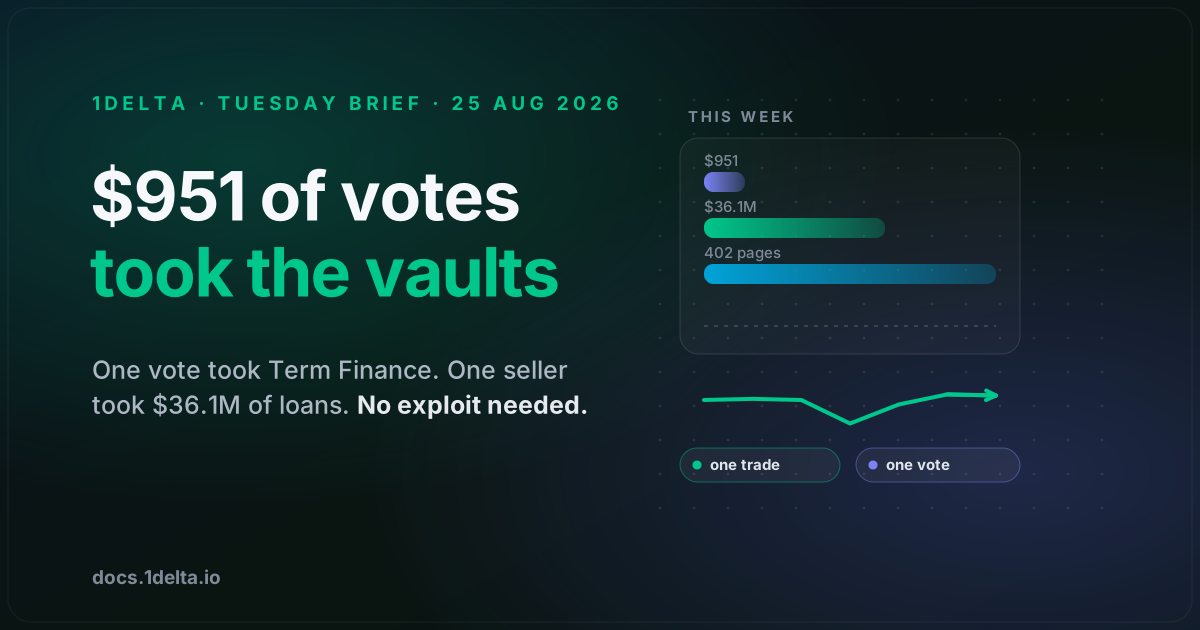
Four things from the past week deserve an engineer's attention. A lending protocol lost most of its vault deposits to a governance position that cost roughly $951. One address sold into a thin Pendle pool and $36.1M of Morpho loans liquidated fourteen minutes later, without a single line of buggy code. A 37% XRP crash printed on Saturday, on one exchange and nowhere else. And the SEC proposed 402 pages of offering rules for crypto investment contracts.
This is the first of a weekly brief we publish on Tuesdays: what moved in on-chain credit, what broke, and what it means if you build against these markets. Everything below is current as of 25 August 2026; the regulatory items are proposals and pending votes, not settled outcomes.
$951 of voting power took Term Finance's vaults
On Sunday, Term Finance, an Ethereum fixed-rate lending protocol, lost an estimated $8.5M from its Meta Vault product: 2,843 ETH (~$6.87M at the time) and 1.68M USDC, immediately swapped to DAI. That was 68% of the $12.45M sitting in the vaults, and nearly all of the ~$8.8M of Ethereum deposits, but only about a third of the ~$25.8M the protocol held in total.
No conventional smart-contract vulnerability was required. The vaults run on Yearn V3 infrastructure, and Yearn has stated the vector was a custom governance wrapper, not standard Yearn setups. The drain ran through the protocol's own governance machinery. The arithmetic that killed it:
- On 17 August the attacker bought 0.4852 tmvETH for roughly half an ETH, about $951, and staked it.
- That stake alone carried 90.66% of all voting power in the pool. The governance token was sparsely held, and nobody else had bothered to stake.
- The wallet's seed funding traced back to 2 ETH through Tornado Cash. That is what funded the wallet, not what the attack cost. The $951 is the price of the governance position; no total has been published.
- The proposal sat open through a six-day veto window. Zero vetoes were cast. It removed the seven-day transaction cooldown, and then it moved the money.
The timelock worked exactly as designed. So did the veto window. Both are only defences if somebody is watching, and a supermajority held by one staker means there is nobody left to watch. Term Labs has irreversibly shut down all Meta Vaults and revoked their DAO governance roles: deposits closed, withdrawals open.
The lending markets were not touched. Term's Strategy Vaults are ERC-4626 wrappers that allocate into Term's own fixed-rate auctions and into variable-rate protocols elsewhere; the markets underneath, about $3.79M of active loans, kept running, and Term's preliminary investigation puts the exploit inside the vault governance mechanism rather than the protocol or its lending markets. That separation is the design working. Auction operation sits with a manager role and risk parameters with a governor role, while the vault DAO's votes reached only vault configuration. What failed was the single domain in which a $951 stake was a supermajority.
The lesson we take from it is about which parameter is the attack surface. A quorum threshold expressed as a share of staked supply is a threshold over whatever fraction of holders happened to show up. On a token where staking participation is 0.5%, "90% of votes" costs three figures. Scaled quorums against total supply, and delegate voting so that unstaked holders still count, are the boring fixes.
Term was not the only thing that broke. Maya Protocol chained six bugs in a single transaction carrying 23 messages, inflating its own accounting to credit ~49.45M CACAO to a thinly capitalised pool. That was a state credit, not a token mint, which is why the pool showed ~99.93% ownership. About $1.7M was extracted directly; the wider damage was CACAO falling 89% and pool value dropping ~$11M. MAYAChain is halted and the attacker still holds 20.83 BTC.
MANTRA stopped producing blocks late on 20 August. The root cause was not its own code: a vulnerability in the Cosmos EVM module, a shared upstream dependency, which Cosmos Labs confirmed also affected Kiichain and TAC. MANTRA's token set a record low, down 18%; validators restarted on the patched v8.4.0 at about 05:30 UTC on 22 August with no rollback and balances unchanged.
Governance capture, a chain of implementation bugs, a shared dependency: three protocols, three unrelated failure classes, one week. The same week, Morpho's DAO added Spearbit as a multisig signer and raised its threshold to 6/10, which is what the other end of this looks like.
One seller, eight minutes, $36.1M liquidated
This one is worth reading closely, because nothing was exploited. Every contract did exactly what it was written to do. The reconstruction below is ours, read from chain data rather than from reporting; the method and anchor transactions are at the end of the section so you can check it.
The setup: two Morpho Blue markets on Ethereum take PT-reUSD-10DEC2026, the Pendle principal token for Re Protocol's reUSD maturing 10 December, as collateral against USDC and USDT. Both run at 91.5% LLTV. Between them they currently carry about $63M of borrows against $79M of PT collateral. That is a classic PT loop: buy the discount, lever it, hold to maturity.
The collateral is priced by a Morpho ChainlinkOracleV2 at 0x217d6DdC…, which reads a single feed at 0x77ee1473…, an Ojo "PT Feed Pendle Chainlink-compatible Oracle". It tracks the PT price in the Pendle AMM. That AMM pool holds about $9M of liquidity.
Pool liquidity and collateral value are not directly comparable quantities. What matters is how much it costs to move the price, not the headline TVL. So here is the measured version: on Tuesday morning, roughly $5M of PT sold into that pool moved its price about 1%, against $79M of collateral valued off it at a threshold that tolerates a 9% move.
Read the sizes again. A one percent move in the collateral price liquidated $36.1M of loans. That does not mean the oracle malfunctioned. The feed reported the price at which PT actually traded, which is what it is specified to do. The open question is whether a spot read of a relatively thin pool is an appropriate collateral valuation for a 91.5% LLTV market, because at that threshold every loop above 90.6% LTV is one percent of collateral away from being closed, and PT loops sit near max LTV by construction: the whole trade is levering a known-small discount.
Two details worth keeping:
The liquidators never needed capital. A single liquidator contract took $34.76M of the $36.1M. Each transaction seizes the PT, re-supplies that same PT as its own collateral in the same market, and borrows USDC against it to fund the repayment, then unwinds over the following hour in million-dollar repay/withdraw pairs. The liquidation incentive was financed by the market being liquidated.
The cascade fed the pool that caused it. Several of the smaller liquidations routed the seized PT straight back into the same Pendle pool, pushing the price further down while the sweep was still running.
How we got these numbers. Morpho markets 0x1e9d6146… (USDC) and 0x6acd1885… (USDT) on Ethereum, read through the Morpho GraphQL API for market parameters, every Liquidation transaction in the window, and the zero bad-debt figure. Oracle addresses and the feed description read directly from mainnet. Swap sizes and execution prices come from the Swap events of Pendle market 0x13285bcb… over blocks 25,829,400 to 25,830,100 via Blockscout; the implied-APY series is the hourly history from the Pendle API. Anchor transactions: the sell burst opens at 0x3bb3f1f0…, the largest liquidation is 0x5168462b…, and the buy-back opens at 0x501c7d24….
For Morpho the headline is zero bad debt. Isolated markets, a hard LLTV and liquidation incentives sized to that LLTV did their job, and suppliers in the Smokehouse USDC and USDT vaults ended the morning whole. The borrowers paid for it.
The implication we draw, and the reason we care: the number to watch is not the LLTV but what it costs to move the price the oracle reads, and whether the feed in that slot is a redemption rate, a discount curve, or a spot read of a pool a few million dollars can shift. Our position layer resolves the oracle behind every market it reads for exactly this reason: a health factor computed against a movable feed belongs in the response with an asterisk, not in a footnote. Two adjacent shapes of the same problem: why LlamaLend names no liquidation price at all, and how fixed-term lending prices debt that does not accrue.
Saturday: a 37% wick on one exchange
The number that travelled was real and almost entirely local. On Bitstamp, XRP/USD set a one-minute high of $1.69739 at 05:03 UTC on Saturday and printed $1.06689 inside the 05:10 candle: a 37.15% high-to-low move. That same candle closed at $1.44837. The hole lasted less than a minute.
It was a Bitstamp event. We pulled the same minutes from Coinbase, where the deepest print was $1.34000 at 05:11 against a $1.69960 high, about 21%. Both books show the identical orderly slide from 05:07 to 05:09, roughly $1.675 down to $1.53. The extra sixteen percentage points existed in one order book and nowhere else.
The day's aggregate deleveraging is a separate fact and should not be pinned on that candle: roughly $500M of XRP longs and $1.35B across the market were liquidated over 24 hours, with Bitcoin down 2.5%, Ether 5% and Solana 11.5%. No single fundamental catalyst has been established publicly.
It earns a paragraph here because of what sits above it. A thin book printed a price no other venue agreed with, and it survived one minute. On a perp venue that price closes positions. In a lending market it becomes a collateral valuation the moment an oracle reads it, which is precisely the question the PT-reUSD markets pose: does the feed in the oracle slot report a price somebody could actually transact at, or the deepest tick of a book that was briefly cleared out?
The SEC published the perimeter
On 18 August the SEC proposed Regulation Crypto Assets (Release 33-11434), 402 pages and the centrepiece of Chair Paul Atkins' "Project Crypto". It is not a rule that decides which tokens may be sold; it is a proposed offering regime for certain investment contracts involving crypto assets, with two exemptions and a conditional safe harbor. It hit the Federal Register on 21 August, so comments close 20 October 2026.
The Commission is writing rules because Congress stalled. The Senate filed cloture on the motion to proceed to the CLARITY Act (H.R. 3633) on 8 August, not on passage, and that vote is now scheduled for 15 September, with three fights unresolved: government ethics rules, whether stablecoin rewards survive, and how far developer protections extend.
It builds on the SEC/CFTC interpretive release of 17 March 2026, which sorted tokens into five buckets: digital commodities, digital collectibles, digital tools, payment stablecoins, and digital securities. The first three are not securities. Stablecoins may or may not be. That release also confirmed that protocol mining, protocol staking, ministerial staking services, staking receipt tokens, one-for-one wrapped tokens and certain airdrops do not involve securities transactions.
What the new proposal adds is a route to sell the contract around a non-security token. Its central term is the covered investment contract: an investment contract where the only asset subject to it is a crypto asset that is not itself a security. Two exemptions:
| Startup exemption | Fundraising exemption | |
|---|---|---|
| Cap | $5M over up to 4 years | $20M (Tier 1) / $75M (Tier 2) per 12 months |
| Filing | Form NOR before offering | Form 1‑CRYPTO offering statement |
| Financials | None | Audited GAAP at Tier 2 |
| Ongoing | Rule 103 disclosures on a public site, updated within 30 days of year‑end on material change | Annual 1‑KC, semiannual 1‑SC, current 1‑UC |
| Exit | Form TR within 4 years | Form TR certification |
And the parts that bite:
- "Covered transaction" expressly reaches airdrops and network rewards. Distribution, not just fundraising, is inside the perimeter, when the distribution involves a covered investment contract. It does not make every airdrop a registered offering: the March interpretation already puts airdrops of non-security assets for no consideration outside securities law. The change is that distribution is now something you have to reason about, not assume.
- A U.S. nexus test gates the fundraising exemption: among other conditions, the issuer must be U.S.-organised, with a majority of officers and directors U.S.-based and 50%+ of assets in the U.S. The stated goal is onshoring; the practical effect is that an offshore foundation does not qualify.
- Rule 103 disclosure runs to ten topics, including security architecture and governance, and your public communications have to stay consistent with what you filed.
- Non-accredited purchasers are capped at 10% of the greater of annual income or net worth.
- The safe harbor is non-exclusive, and preemption is conditional. The covered investment contract ceases to exist once the issuer completes its promised "essential managerial efforts", makes no new representations, and files a Form TR with supporting analysis, but that certification stays open to challenge, and state preemption lapses if the issuer falls out of compliance.
- It does not resolve market structure. The safe harbor reaches the term "investment contract" in the security definitions of both the Securities Act and the Exchange Act, but broker-dealer, exchange and trading-system registration, the questions that govern where these assets can actually trade, are untouched.
Markets read the direction, not the fine print. Bitcoin cleared $80,000 on Tuesday for the first time since mid-May, capping the best week in three years, roughly +24%, with more than $3B of shorts liquidated and about $1.92B of spot ETF inflows, the strongest in ten months. The rally coincided with the Treasury doubling long-dated bond buybacks from $2B to $4B, the SEC proposal, and the 21 August White House crypto summit; which of those did the work is an argument, not a measurement. Bitcoin is still roughly $34,000 below where it traded a year ago.
The headwind is not in the price; it is that the rule prices distribution. Covered transactions that reach network rewards, a U.S. corporate nexus, and reporting tied to a decentralisation certification draw a compliance perimeter around the mechanisms DeFi uses to bootstrap. The framing throughout, built on "essential managerial efforts" and issuer accountability, presumes an issuer who can be held to promises, which is precisely the role most protocols spent years engineering away.
What we are watching
- Whether Term's vault shutdown leaves depositors whole, and whether other governance wrappers get audited for staked-share quorums before someone repeats the trade.
- Whether the PT-reUSD markets keep $63M of borrows against a $9M AMM, or whether curators cut the LLTV, cap the market, or move the oracle to a discount curve.
- Comment letters before the 20 October deadline, specifically on the airdrop and network-reward treatment, the clause with the widest blast radius, plus the CLARITY procedural vote on 15 September.
- Stablecoin supply, which peaked near $322B in mid-May and was down to roughly $308B by 2 August, the deepest drawdown since Terra, with June alone shedding $11.4B. That is the collateral base under everything above, shrinking while borrow demand loops harder.
Sources: The Block and CoinDesk on Term Finance; Cointelegraph for the Yearn statement and Cryptonomist for Term's preliminary finding that the lending markets were unaffected; CoinDesk on Maya and CoinDesk on MANTRA, with the Cosmos EVM root cause and restart from MANTRA's status page, crypto.news and BeInCrypto. Liquidation figures, market parameters and oracle addresses read from the Morpho API and Ethereum mainnet; swap-level data from the Pendle market at 0x13285bcb… via Blockscout and the Pendle API. SEC: press release 2026-76, proposing release 33-11434, the Federal Register notice for the 20 October comment deadline, and summaries from Morrison Foerster and Sidley. CLARITY status from CoinDesk. Market data from Bloomberg and The Block; XRP candles read from the Bitstamp and Coinbase Exchange public OHLC APIs, with the 24-hour liquidation totals from Coinglass via CoinMarketCap and CoinDesk; stablecoin supply from Bitcoin.com News.