The stablecoin-native chains, compared
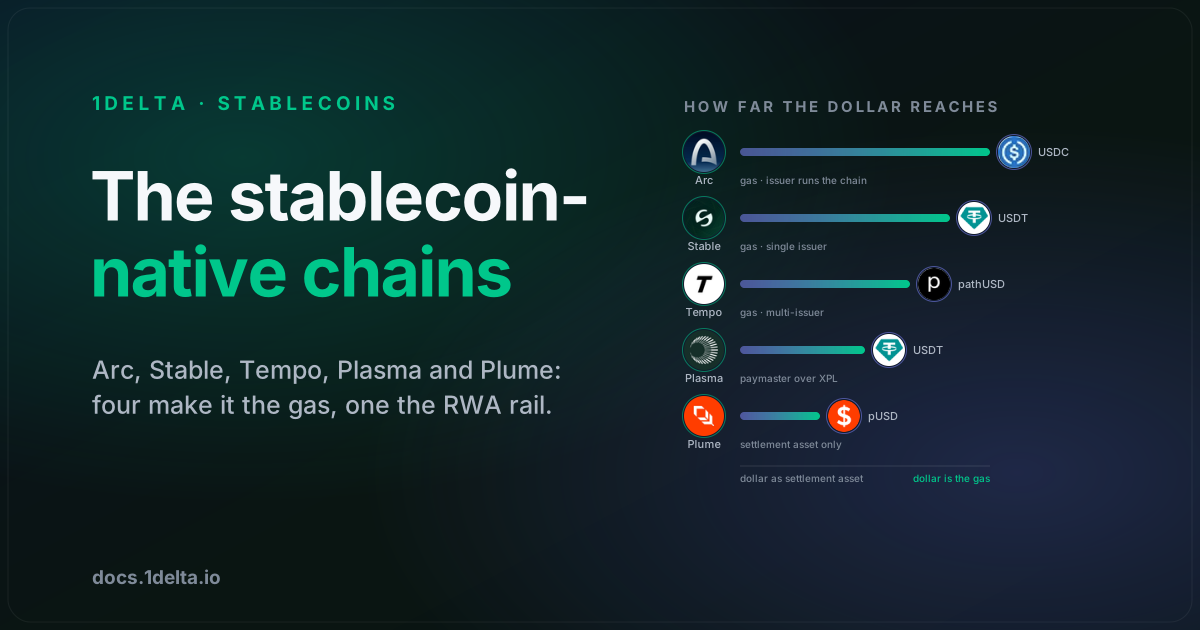
Arc, Stable, Tempo, Plasma and Plume each put a stablecoin at the centre of the chain. Four make it the gas token; one makes it the settlement rail for RWAs.
For most of crypto's history, stablecoins were tenants. USDT and USDC paid rent on Ethereum, Tron and Solana, and the chain underneath captured the gas in its own volatile token. The 2025–2026 wave produced a class of chains built the other way round: the stablecoin is central to the chain's architecture or its economic proposition, and everything else is arranged around it.
The float is worth fighting over. As of 17 September, USDT is at $183.2B and USDC at $73.8B in circulation, against a USD-pegged total of roughly $311B, per DeFiLlama. For an issuer, the gas those dollars pay on Ethereum or Tron is revenue going to someone else, and a chain of your own is one way to keep some of it.
Five chains define the category right now, and they centralise the dollar in three different ways. Arc, Stable and Tempo make a stablecoin the gas token. Plasma sponsors stablecoin gas through a paymaster while a volatile token secures the chain underneath. Plume makes a stablecoin the settlement rail for real-world assets and keeps a conventional gas token. One question, how to make the dollar the thing everything else flows through, and three answers.
The five, side by side
| Arc | Stable | Tempo | Plasma | Plume | |
|---|---|---|---|---|---|
| Backer | Circle | Tether-aligned (USDT0 team) | Stripe + Paradigm | Tether, Bitfinex, Founders Fund | Independent (Haun, Brevan Howard, Galaxy, Apollo) |
| Canonical stablecoin | USDC | USDT0 | Multi-issuer (USDC, USDB, pathUSD) | USDT (native, not bridged) | pUSD |
| The stablecoin's role | Gas token | Gas token (USDT0) | Gas token (multi-issuer) | Sponsored gas (paymaster) | Settlement / RWA entry-exit |
| EVM-compatible | Yes | Yes | Yes | Yes | Yes |
| Status | Mainnet (Sep 16, 2026) | Mainnet (Dec 8, 2025) | Mainnet (Mar 18, 2026) | Mainnet beta (Sep 25, 2025) | Mainnet (Apr 2025) |
| DeFi TVL, 17 Sep 2026 | $339M | $36M | $61M | $583M | $5.5M |
| The point | Institutional settlement, agentic finance | USDT is gas, not a wrapper | Payments distribution (Stripe) | Zero-fee USDT, Bitcoin checkpoints | RWA tokenisation |
The row that matters is how gas is paid; it explains most of the other differences. The TVL row is DefiLlama's chain figure this morning, and it is the one row the launch announcements do not mention.
Arc: USDC as the native gas token
Circle launched Arc mainnet on September 16, 2026, with BlackRock, DTCC and Visa in the validator set. It is an EVM-compatible Layer 1 where USDC is the gas token. An ARC token exists (Circle minted the full 10 billion supply at genesis), but it is not used for gas, and Circle says the mint is not a commitment to launch it publicly. Nobody has to hold a second asset to move dollars.
Most chains charge gas in a volatile native token, so every USDC holder ends up holding something else just to transact. Arc removes that from the user's side. Through a paymaster, other fiat stablecoins and tokenised fiat instruments can also cover gas, and the chain's own accounting is dollar-denominated end to end.
The design is pointed at institutional settlement and agentic finance: agents that move money on behalf of a user should not have to manage a volatile gas position, and a chain wired to CCTP means USDC moves in and out without wrapping. USDC keeps its Ethereum and Tron footprint; what Circle gains is a settlement environment it controls directly.
Circle calls it an "economic OS": the network, wallets, on/off-ramps and tooling an issuer, agent or treasury needs to settle in dollars, sold together. Day one shipped sub-second payment finality, 16 stablecoins (USDC plus fiat-currency partners, not just USDC), Arc Studio for deploying a contract by talking to an AI, and an agent stack (marketplace, reputation and nano-payments) aimed at making AI agents first-class economic actors. The validator set is permissioned: Circle plus eleven founding institutions, among them BlackRock, DTCC, Visa, Mastercard and ICE, with a proof-of-stake handoff planned.
Day one was a lending day. Our DefiLlama snapshot at 20:30 UTC on 16 September showed $333.7M of TVL, 91% of it in Morpho and Aave V4; the numbers are in this week's brief.
For a builder, the interesting property is the absence of a native-token subsidy. There is no fee token that appreciates with usage, which means the chain's economics have to come from stablecoin flow itself: fees, liquidity, and the value of settling on a rail whose issuer is also the validator's counterparty.
Stable: USDT0 itself as gas
Stable takes Plasma's idea one step further. Rather than a paymaster sponsoring gas behind the scenes, Stable makes USDT0 the gas asset itself, and USDT0 transfers carry no protocol-level fee. Users never need a second token to transact. A STABLE token does exist, launched with the chain for staking and governance, so the network's security economy is not dollar-denominated even though the user's is. Stable is associated with the USDT0 cross-chain transport team and positioned as a Tether-aligned settlement layer for remittance, payroll and merchant flows.
On Plasma, users pay USDT and a paymaster covers XPL underneath. On Stable, the transaction is priced and settled in USDT0. For a treasurer, that means the fee side of the chain tracks the dollar rather than the chain's own token.
Mainnet went live on 8 December 2025, together with the STABLE token generation event. Nine months on, DefiLlama has the chain at $36M of DeFi TVL: live, but a small fraction of Plasma's $583M on the same USDT thesis.
Tempo: payments distribution, multi-issuer gas
Tempo is the Stripe and Paradigm answer. Announced in September 2025 after a $500M Series A at a $5B valuation, it went live on March 18, 2026 as a payments-first L1 with stablecoin-native gas and no native token.
Where Arc is USDC-single and Stable is USDT-single, Tempo is deliberately multi-issuer. Its TIP-20 token standard lets gas be paid directly in USDC, USDB, pathUSD and other supported stablecoins, so a merchant can run entirely in the asset its customers already hold. Tempo reports sub-second finality and a 20,000 TPS figure from testnet benchmarking, and Stripe contributes the thing the others lack: distribution. Stripe processes well over $1.4T a year, and any meaningful share of that flowing through a Stripe-controlled rail reshapes where stablecoin volume lives.
Klarna is the named customer: KlarnaUSD is live on Tempo's testnet with a mainnet rollout planned for 2026, which would put a consumer-facing stablecoin with real merchant flow on the chain. That has not happened yet. What has: the chain cleared $1B in 30-day stablecoin transfer volume by September, against $61M of DeFi TVL on DefiLlama this morning. Tempo's ambition is to be Stripe's default settlement rail, and the bet appears to be that issuer neutrality plus Stripe's distribution wins merchant volume.
Plasma: Tether's home chain
Plasma was first. Launched in mainnet beta on September 25, 2025 from the Tether/Bitfinex orbit with Founders Fund and Framework among lead investors, it launched with $2B in stablecoin liquidity across more than 100 DeFi partners.
Tether has confirmed USDT is canonically issued on Plasma rather than bridged, with USDT0 as the cross-chain transport layer. The gas design is a paymaster: for plain USDT transfers, a Foundation-managed XPL allowance sponsors the gas, which is why zero-fee USDT transfers are the headline product. Approved ERC-20s can also be used as custom gas tokens. Checkpoints settle to Bitcoin for additional security.
The ambition is a Tether home chain for global payments and remittance: USDT issued natively rather than bridged, settled to Bitcoin, with zero fees on the transfer itself. The traction beyond USDT is that Circle brought USDC and EURC to Plasma natively in August 2026, so the "Tether home chain" now hosts the two largest stablecoins side by side.
The paymaster model keeps a volatile token in the loop. The user's experience is stablecoin-native; the network's security and execution economy is XPL-based, and the Foundation's allowance has to be topped up for the subsidy to continue. It is also, by a wide margin, the most-used chain in this group: $583M of DeFi TVL on DefiLlama today, against $339M on Arc a day after launch.
Plume: the stablecoin as the RWA rail
Plume is the outlier. It is an RWA-tokenisation chain that launched mainnet in April 2025 with built-in compliance, a native oracle, and 180+ DeFi integrations. Its native token is PLUME, and gas is not the stablecoin.
What makes Plume part of this conversation is pUSD. Plume USD is a fully-backed, 1:1-pegged stablecoin collateralised by USDC in a BoringVault: mint by depositing USDC, redeem at par, zero fees. It is the canonical dollar of the chain, used for payments, trading and collateral across the ecosystem.
pUSD centralises the entry and exit rail for RWA flow. A subscription to a tokenised treasury, a secondary trade, or a private-credit commitment all settle in the same on-chain dollar, so the chain never needs its users to hop between USDC, USDT and a bridge to move value into and out of an asset. Where Arc and Plasma use a stablecoin to price transactions, Plume uses one to price assets. It is the same centralisation mechanism pointed at a different product. Plume told the SEC it had $4.5B of assets committed for tokenisation as of April 2025, and SkyLink distributes RWA yield across 18 networks. The bet is that the dollar rail is what makes RWA positions composable with the rest of DeFi.
The numbers since have gone the other way. Plume's own quarterly updates put RWA TVL at $340M at the end of Q1 2026 and $115M at the end of Q2, and DefiLlama has the chain's DeFi TVL at $5.5M this morning. Whatever was committed in April 2025, very little of it is sitting on the chain in September 2026. The ambition is still RWA tokenisation at scale and eventually retail (most positions sit behind accredited-investor checks through Plume Passport), but Plume is the one chain in this group where the shipped column has been shrinking.
What the gas mechanism actually decides
Put the five on a spectrum of how far the stablecoin reaches into the chain's plumbing:
- Plume: the stablecoin is a settlement asset, not gas. The chain is sovereign but its dollar is a wrapped reserve.
- Plasma: the stablecoin is what users pay, but a volatile token (XPL) still funds the paymaster underneath.
- Tempo: the stablecoin is gas, and no volatile token exists, but it is multi-issuer, so the chain does not bet on a single dollar.
- Stable: the stablecoin is gas, single-issuer, no wrapper on the user's side; a STABLE token secures the chain underneath.
- Arc: the stablecoin is gas and the issuer is the validator's counterparty, collapsing the "chain vs. issuer" split entirely.
The spectrum comes down to one question for anyone building on these rails: whose balance sheet backs your settlement layer, and what happens to you if it walks away? Arc and Stable lose most of their utility if USDC or USDT0 were withdrawn. Tempo and Plume keep more optionality, at the cost of a less concentrated settlement asset. Plasma's exposure is the XPL allowance that funds its subsidy.
Ambition versus shipped
A chain's ambition tells you what it is for; what it has actually shipped tells you how far along the thesis is. The gap between the two is the risk.
| Chain | The ambition | Shipped so far |
|---|---|---|
| Arc | "Economic OS": settlement for agents, tokenised assets and payments | Mainnet (Sep 16, 2026), USDC gas, sub-second finality, 16 stablecoins day-one, Arc Studio/Arc Kits, agent marketplace + nano-payments, $339M DeFi TVL on day two |
| Stable | USDT0 as gas for remittance, payroll and merchants | Mainnet (Dec 8, 2025), STABLE TGE, zero-fee USDT0 transfers, $36M DeFi TVL |
| Tempo | Stripe's default settlement rail, cards and the AI economy | Mainnet (Mar 18, 2026), $500M raise, KlarnaUSD on testnet, $1B 30-day transfer volume, $61M DeFi TVL |
| Plasma | Tether's canonical home chain and a zero-fee remittance rail | Mainnet beta (Sep 25, 2025), 100+ DeFi partners, native USDC/EURC, $583M DeFi TVL |
| Plume | RWA tokenisation at scale, opened to retail | Mainnet (Apr 2025), pUSD rail, SkyLink across 18 networks; RWA TVL $340M → $115M across H1 2026, $5.5M DeFi TVL today |
All five have shipped a mainnet. Read by TVL, they sort into three tiers: Plasma and Arc with hundreds of millions, Tempo and Stable with tens, and Plume with single digits after a year of decline. The ambition column is marketing until the shipped column catches up, and in one case the shipped column is moving the wrong way.
What it means for builders
For a lending or margin protocol, a stablecoin-native chain changes two things that the pool model takes for granted.
The float is the gas. When USDC is the native gas token, a position's collateral, its debt and its transaction fees are the same asset. That removes a whole class of operational friction that every multi-chain lending integration currently has to special-case: sourcing the native token to pay gas on a liquidation, a repayment or a margin call. The same logic that makes a unified lending balance across chains worth building becomes cheaper to build when the chain's own accounting is dollar-denominated.
The chain's incentives are the product's incentives. A chain whose validator economics are dollar-denominated has no interest in a volatile token's price, which aligns it with the lenders, borrowers and treasurers who settle in dollars. That is the same bet the CDP model makes at the protocol level: mint the stablecoin against collateral, and the whole system is denominated in the asset it actually settles. A stablecoin-native chain extends that idea up one layer, to the chain itself.
The unresolved question is whether the float migrates. Tether and Circle can announce chains, but the $311B is already settled on Tron, Ethereum and Solana, and a new rail has to be cheaper or more useful than moving to it. The mainnet launches have happened. What to watch is whether canonical issuance, zero-fee transfers and payments distribution pull real volume off the incumbents.
What we are watching
- Whether Stable's $36M grows, or whether the USDT thesis has already picked its chain in Plasma.
- Whether Arc's institutional validator set (BlackRock, DTCC, Visa) produces settlement volume or just governance optics.
- Whether Tempo's Stripe distribution converts $1.4T of payment flow into stablecoin volume faster than Tether and Circle convert their own float.
- Whether Plume arrests the decline (RWA TVL fell two-thirds across the first half of 2026), and what a pUSD rail is worth on a chain with $5.5M of DeFi on it.
Sources:
- Circle launches Arc mainnet with BlackRock, DTCC and Visa as validators · Decrypt
- Circle Opens Arc Mainnet · Stablecoin Insider
- Best Stablecoin L1 Chains in 2026 · Eco
- Stripe-led payments blockchain Tempo goes live · CoinDesk
- Stripe, Paradigm and the Tempo blockchain · Fortune
- Tempo surpasses $1B in 30-day stablecoin transfer volume · Crypto Briefing
- Plasma stablecoin chain mainnet beta · The Defiant
- USDT vs USDT0 · Datawallet
- Plume Network: RWA Tokenization · CoinGecko
- Arc Mainnet, AI Agents, and Tokenized Markets · Bankless (Nikhil Chandhok)
- The Fintech Integration Wave: Neobanks Connecting to Stablecoin Rails · Yahoo Finance
- Plasma news and updates · CoinMarketCap
- Stable launches mainnet and native token · The Block
- Klarna announces KlarnaUSD on Tempo · The Block
- Tempo performance · Tempo docs
- Why build on Plasma · Plasma docs
- Plume written input to the SEC Crypto Task Force, May 2025
- Plume Update: Q1 2026 and Q2 2026
- DeFiLlama · Stablecoins; chain TVL figures for Arc, Stable, Tempo, Plasma and Plume read from the DeFiLlama API on 17 September 2026