Market curation and vault curation: one curator, two jobs
Sentora curates $1.32B of Morpho vaults and, since 22 October, the first externally curated market on Aave V4, against the same collateral at the same limits. On Morpho it moves the deposits; on Aave it sets the terms. The timelocks (72h vs 48h), the cancel rights, the keys, the fees (10% vs 20%) and the exits differ, and the SEC and ESMA have started describing the two jobs separately.

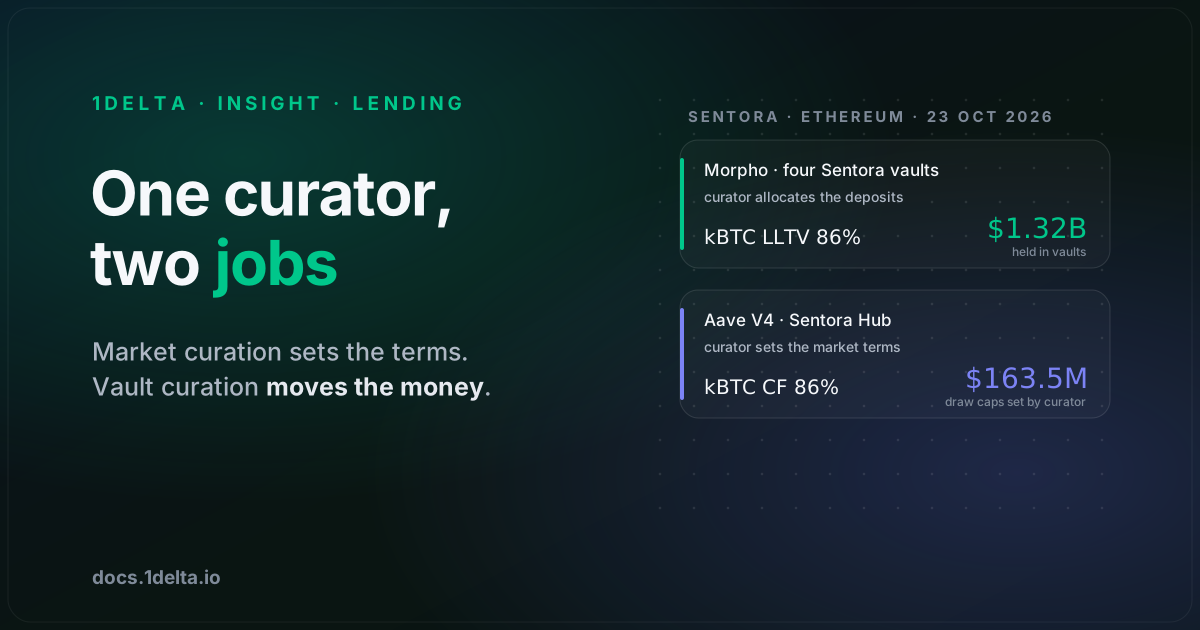
Sentora is the only lender in a Morpho market that holds $265M of RLUSD against kBTC at 86%. On 22 October it opened a market on Aave V4 that lends RLUSD against kBTC at 86%. Same firm, same collateral, same number, and a different job: on Morpho Sentora allocates $1.32B of other people's deposits, on Aave V4 it sets the terms of a market that deposits enter directly. At block 26,255,647 (23 October, 13:32 UTC, nineteen hours after launch) the two roles differ like this:
| Sentora on Morpho (vault curator) | Sentora on Aave V4 (market curator) | |
|---|---|---|
| What Sentora controls | where $1.32B of deposits go, across four vaults | collateral list, collateral factors, rate curves, oracles, draw caps |
| What it cannot touch | the markets' terms, fixed at creation | which Hub a supplier's money sits in |
| Money at work | $1.32B in the four largest vaults, sole lender in every market they fund; $1.28B of collateral posted, $903M borrowed | 106.9 RLUSD supplied, no collateral, nothing borrowed; $163.5M of draw caps |
| Age | oldest vault ten months; each reached $50–100M within one to six weeks | one day |
| Delay on a risk increase | 72h (vault timelock) | 48h (payloads controller) |
| Who can stop a pending change | vault sentinel | V4 Security Council or Sentora itself; the DAO cannot in time |
| Keys with instant power | curator can cut caps; sentinel can deallocate | one EOA can pause every reserve (blocks withdrawals, repayments and liquidations) and halt the Spokes at the Hub, no delay; lifting a pause takes a 48h payload or the Security Council |
| Code upgradeable | no | yes, by the V4 Security Council |
| Depositor exit under stress | forced in-kind exit, up to 2% penalty | idle liquidity only |
| Sentora's cut | 10% of yield | 20% liquidity fee, half to the DAO |
Everything below unpacks that table, then puts it against what the SEC and ESMA have said about each job. Neither regulator has named a curator or ruled on either model. Both have begun to describe the two roles separately, and the table is the set of facts those descriptions turn on.
Aave Labs announced the launch as the first externally curated markets on Aave V4: a Liquidity Hub on Ethereum with three Spokes, borrowing RLUSD, PYUSD and OUSD against USDe, kBTC and a short list of yield-bearing assets. Sentora chooses the collateral, the collateral factors, the rate curves and the oracles. The Aave DAO keeps the contracts.
Two jobs
Market curation is setting the terms of a lending market: which assets count as collateral, how much can be borrowed against each (LLTV on Morpho, collateral factor on Aave V4), which oracle prices them, the rate curve, liquidation bonuses, and supply and borrow caps. A depositor in that market takes the terms as given and decides whether to be there.
Vault curation is deciding where pooled deposits go: which markets a vault may lend into, how much of the pool each market can take, who is allowed to move funds between them, and what the vault charges. A vault depositor hands that decision to the curator.
Aave V3 has only the first job, done by the DAO and its risk service providers; each user picks the reserve they supply to. Morpho splits the two: a Morpho Blue market's five parameters (loan asset, collateral asset, oracle, IRM, LLTV) are fixed at creation and cannot be changed, so every ongoing decision sits in the vaults that fund those markets. Aave V4's external curation puts the ongoing decisions back into the market.
Sentora in both roles
Sentora's four largest Morpho V2 vaults on Ethereum, the markets they lend into, and the matching Spoke on its Aave V4 Hub:
| collateral → loan | Morpho LLTV | Sentora vault supply | share of market | utilisation | Aave V4 Sentora Spoke | CF | Hub caps |
|---|---|---|---|---|---|---|---|
| kBTC → RLUSD | 86% | $265.0M (RLUSD Main) | 100% | 90.7% | Bluechip | 86% | 580 kBTC in, 30M RLUSD drawn |
| kBTC → PYUSD | 86% | $126.3M (Paypal USD Main) | 100% | 90.1% | Bluechip | 86% | 30M PYUSD drawn |
| USDe → RLUSD | 91.5% | $62.2M (RLUSD Main) | 100% | 90.0% | RLUSD Yield | 91.5% | 50M USDe in, 90M RLUSD drawn |
| PRIME → PYUSD | 86% | $210.1M (PRIME Main) | 100% | 88.0% | RLUSD Yield | 89.5% | cap 0 |
| sUSDe → PYUSD | 91.5% | $109.6M (Paypal USD Main) | 100% | 89.1% | not listed | ||
| weETH → RLUSD | 86% | $100.3M (RLUSD Main) | 100% | 88.8% | not listed |
Morpho figures from the Morpho API for each vault adapter's positions; Hub figures from getSpoke and getDynamicReserveConfig on the Spoke contracts, and Aave Pro's curator API reports the same Hub totals. "Share of market" is the vault's supply divided by the market's total supply.
Sentora's vault is the only lender in every one of these Morpho markets. Whoever deployed each market fixed its terms that day. Whether the market has a dollar to lend is Sentora's call, made through vault caps and allocations it can change on a 72-hour delay. A Morpho depositor who wants kBTC exposure at 86% gets it because Sentora put it there, and keeps it until Sentora moves it.
The borrowers on the other side of the kBTC markets are Sentora as well. kBTC is Kraken Wrapped Bitcoin; 6,295 of the 7,028 kBTC on Ethereum sit in Morpho Blue, and $435M of the $511M of kBTC collateral across the two markets is posted by four LoanManager contracts whose source carries @author Sentora Corp and whose owner is the "Advanced Strategies BTC" vault (sentoraBTC), a Veda BoringVault with 6,691 shares minted on Ink. That vault is Kraken's Bitcoin Vault: customer BTC is wrapped to kBTC, sent to Ink, deposited into the Veda vault that Sentora manages, posted as collateral to borrow stablecoins, with a 25% performance fee and a three-day withdrawal wait. So in the kBTC → RLUSD market Sentora's stablecoin vault lends, at terms Sentora chose, to Sentora's bitcoin vault. The vault curator sits on both sides of the loan, and the LLTV between them is the one number it cannot move.
On the Hub the lever flips. A supplier deposits RLUSD into the Hub and earns what the Spokes pay. No allocator moves that RLUSD between venues. Sentora instead changes what the RLUSD is lent against: raise kBTC's collateral factor, list a new asset, reshape the curve, lift a Spoke's draw cap. The draw caps are where the two jobs touch. A cap on how much RLUSD the Bluechip Spoke may pull from the Hub is an allocation decision over pooled deposits, and the party making it is the party that also sets the Spoke's terms.
Two of the assets Sentora lends against on Morpho are off on the Hub. A pre-launch payload the V4 Security Council executed on 16 October paused mWIN and set the PRIME and PST supply caps to zero on both Yield Spokes. The ARFC lists mWIN at an 84.6% collateral factor; Sentora's Morpho mWIN vault shrank from $22.4M to $6.1M in the week around that payload. Today the Hub accepts exactly two collaterals, USDe and kBTC.
The timelock moved
| Morpho Blue market | Sentora RLUSD Main (Morpho Vault V2) | Sentora Hub (Aave V4) | |
|---|---|---|---|
| Collateral, LTV, oracle, rate curve | fixed at creation | not the vault's lever | Sentora, through a payloads controller with a 48h delay |
| Where deposits go | curator sets caps per market, allocator moves funds inside them | supplier picks the Hub; Sentora sets per-Spoke draw caps | |
| Delay before risk increases | none possible | 72h on cap increases and new adapters | 48h on every payload |
| Can a pending change be cancelled | sentinel can revoke | V4 Security Council (guardian) or the Sentora operator | |
| Instant risk-reducing actions | curator cuts caps, sentinel deallocates | Sentora emergency EOA: pause or freeze reserves, halt assets or Spokes at the Hub, reset caps | |
| Contract upgradeable | no | no | yes, Hub proxy admin owned by the V4 Security Council |
| Exit without the operator | withdraw idle liquidity | forceDeallocate into the underlying position, up to 2% penalty | withdraw idle liquidity |
| Operator fee | none | 10% performance fee | 20% liquidity fee on the three stablecoins, half to the DAO under the ARFC |
Sentora RLUSD Main: timelock(bytes4) returns 259,200 seconds for increaseAbsoluteCap, increaseRelativeCap and addAdapter; performanceFee() returns 10%. Hub: AccessManager at 0xbb8C…A7A2, payloads controller at 0x6f93…d2d6.
The ARFC the DAO voted on describes a 48-hour delay set on a SENTORA_MANAGED_ROLE in the Hub's AccessManager, with the line of code spelled out: grantRole(SENTORA_MANAGED_ROLE, sentoraAddress, 172800). That role does not exist on the deployed Hub. Every role on the AccessManager carries an execution delay of zero and no role has a guardian. Sentora's routine powers (listing, rates, oracles, liquidation settings, caps, collateral factors) belong to a Sentora Executor contract whose sole owner is a PermissionedPayloadsController, and it is that controller that holds each payload for 172,800 seconds. Its payloads manager is 0x6748…F40F, labelled Sentora Operator in Aave's address book, and cast code on it returns nothing: an ordinary wallet, one key. The emergency role sits with no delay on 0x3740…4fAF, labelled Sentora Emergency Admin: also an externally owned account, nonce zero, never used. The Security Council Safe and its executor hold the same role. The fee receiver for all eight assets is owned by a third address labelled Sentora Fee Admin, also an EOA. Whether the three are held by different people, a custodian or one operator is not visible on chain.
What that one key can do matters more than what it is. In the V4 source a paused reserve rejects supply, withdraw, borrow, repay and liquidation; a frozen one rejects only new supply and borrow. haltSpoke on the Hub stops a Spoke adding, removing, drawing or restoring any asset, which stops withdrawals too. So the emergency key can lock every position on the Hub in one transaction, with liquidations frozen while it lasts. Lifting a pause is a role 400 call, which for Sentora means a payload and 48 hours; the Security Council's executor can do it at once. A Morpho vault sentinel's instant powers run the other way: deallocate and revoke pending changes, never lock a withdrawal.
Depositors get what the ARFC promised in substance: 48 hours of visibility on anything Sentora queues and instant risk reduction. Who can stop a queued change is a shorter list than the DAO. A forum participant tested the AccessManager on a fork before launch and found that an Aave governance vote takes longer than 48 hours to execute, so the DAO cannot cancel inside the window. On the deployed Hub the cancel right belongs to the V4 Security Council, an eight-signer Safe, or to Sentora itself. The DAO's remaining move is to revoke Sentora's roles by vote, after the change has gone through.
Activation went down the same pipe. The ARFC passed a Snapshot vote; we found no Aave Improvement Proposal after it. Sentora's operator wallet created and queued payload 0 on 20 October, and it executed on 22 October at 18:40 UTC, unhalting every asset on every Spoke. The first externally curated Aave market was switched on by its curator.
Day one against the vaults' first weeks
Aave's argument for curating a V4 Spoke instead of a vault is liquidity. Stani Kulechov put it as: a curation vault starts at zero and has to be filled with deposits or incentives, while a Spoke can draw on the Hub's balance sheet from launch. Aave's market structures post describes credit lines from deep Hubs like Core as the way to seed new markets.
Sentora's Hub has no credit lines. The ARFC forbids them and requires a separate proposal under the Aave Risk Framework for any line to or from a DAO Hub; LlamaRisk confirmed that such a line would bring the instance inside its mandate and the full risk standard. So the Hub started where a vault starts, and the useful comparison is with how Sentora's own vaults started.
| Sentora vault (Morpho, Ethereum) | created | first week | reached $100M | now |
|---|---|---|---|---|
| Paypal USD Main | 16 Dec 2025 | 29 Jan 2026 (six weeks) | $369M | |
| Sentora RLUSD Main | 5 Mar 2026 | $58M | 2 Apr 2026 (four weeks) | $486M |
| Sentora PRIME Main | 8 May 2026 | $8M | 16 Jul 2026 (ten weeks) | $215M |
| Sentora x Spark RLUSD | 1 Sep 2026 | 17 Sep 2026 (16 days) | $250M | |
| Sentora Hub (Aave V4) | 22 Oct 2026 | 106.9 RLUSD after 19h |
Vault history from the Morpho API, weekly totals. The Spark vault went from $0 to $39.6M on 15 September and $239.6M on 17 September.
The vaults did not fill by trickle either. The Spark vault's $240M arrived in two days because Spark put it there, which is the vault world's version of a credit line: a partner's balance sheet, committed by that partner's decision. The Hub's draw caps are set for $163.5M. Whether RLUSD, PYUSD or OUSD issuers, or Sentora's own vault depositors, seed it the way Spark seeded the vault is the question the first weeks will answer, and a one-day read cannot. What the day-one read does settle is that the shared balance sheet reaches a curated Hub only through a credit line, and a credit line is the step that turns the curator's parameters into the DAO's risk. Until one exists, a curated Hub competes for deposits the way a vault does, at a 20% fee on the yield instead of 10%.
What regulators have said about each job
No regulator has ruled on either role. Three documents from the last three months describe them, and they describe them differently.
The SEC, July. Commissioner Hester Peirce's statement Headstands and Summervaults (22 July 2026) gives two lists. For vaults, the activities that may need analysis are "selecting the yield-generating activities, re-allocating assets among yield-generating assets, or selecting the parties that will make those decisions." For lending strategies, they are "setting interest rates, deciding which assets to accommodate, setting loan-to-value limits, and establishing liquidation thresholds." The first list is vault curation. The second is market curation, and it reads like the role list in Sentora's ARFC.
She attaches different legal hooks to each. A vault "could be a common enterprise" under Forman, could "fall into investment company territory", and could look like anything from a unit investment trust with "little or no active management" to a separately managed account. Lending strategies carry implications "that do not turn on the assets involved": onchain loans "can bear the hallmarks of notes that are securities" under Reves. Managing either "may implicate investment adviser issues." The statement is one commissioner's view, and the Chairman and a fellow commissioner marked her departure from the Commission on 1 October.
The SEC, October. The Commission's proposed custody rules for advisers and funds (Release IA-7023, comments due 7 December) include a section on depositing client assets into DeFi. It does not mention curators. The questions it asks are the rows of the table above. Question 172 asks whether the analysis should "turn on the extent of the associated protocol's decentralization" and how an adviser should weigh "the possibility of any upgrades to the smart contract's code". Question 174 asks about receipt tokens where restrictions "are enforced by the smart contract's code and not subject to the discretion of any person or group of persons", and separately about "vault tokens that entitle the holder to a share of assets held in a smart contract as opposed to the specific asset the holder deposited". Question 178 points at "designated addresses with administrative privileges to perform critical operations such as upgrading and modifying the contract's logic and parameters". The Sentora Hub has such addresses: the two Sentora EOAs and the Security Council. These are questions in a proposed rule, not a test; what they show is which facts the Commission is asking advisers to establish before depositing into a protocol.
ESMA, September. ESMA's response to the Commission's MiCA review (30 September) never uses the words vault or curator. It asks for a definition of DeFi that is "as narrow as possible" and warns of "decentralisation washing, where an identifiable operator relies on DeFi-type language to avoid MiCA obligations." It proposes a new regulated service for firms that give clients access to DeFi protocols, with duties including "transparency regarding protocol selection and routing practices" and "due diligence on protocols made available". On borrowing it says the regime should focus on intermediaries "rather than attempting to regulate autonomous protocols directly." The closest it comes to the vault question is in the staking section, where treatment should depend on "the degree of intermediation, control over clients' assets, pooling and discretion exercised by the service provider." That sentence is written about validator selection, and ESMA treats lending and borrowing in a separate section that proposes disclosure duties rather than a new authorised service. Read as a signal of what ESMA looks for, the themes are an identifiable operator, intermediation, pooling and discretion. Nobody holds ongoing discretion over an immutable Morpho market's own parameters after deployment; the discretion sits with whoever funds it. A curated Hub has a named operator with ongoing control over the terms, three separate administrative addresses and a 50% revenue share. Those are the facts a regulator would weigh. They do not decide the classification on their own.
We found nothing from FINMA on either role. Its January custody guidance does not address DeFi.
The two jobs against those tests
Put the facts the regulators keep asking about next to the two setups.
| fact | Morpho Blue market | Morpho vault (Sentora RLUSD Main) | Aave V4 curated Hub (Sentora) | Aave V3 Core |
|---|---|---|---|---|
| identifiable party with ongoing discretion | none after creation | curator, allocators | Sentora, Security Council | DAO, risk stewards |
| that discretion covers allocation of pooled deposits | no | yes | via draw caps | no |
| that discretion covers market terms | no | no | yes | yes |
| admin can upgrade code | no | no | yes | yes |
| exit enforced by code without the operator | when liquid | forceDeallocate | when liquid | when liquid |
| operator paid from depositors' yield | no | 10% performance fee | share of 20% liquidity fee | DAO reserve factor |
Vault curation shows up in the pooling and allocation rows, the things Peirce's first list, ESMA's staking passage and the SEC's vault-token question point at. Market curation shows up in the terms and upgradeability rows, the things Peirce's second list and the SEC's admin-privilege questions point at. An immutable Morpho market has empty rows after the day it is created, and the discretion has moved to whoever funds it, which is why a regulator looking at Sentora's Morpho business would look at the vault, not the market. None of these rows decides whether a curator is an adviser, a vault is an investment company or a loan is a note. Peirce's statement says the answer "will come down to the specific facts and circumstances"; the rows are those facts.
The argument between Aave and Morpho over the past month maps onto the same rows. Paul Frambot proposed classifying vaults as noncustodial when "users can opt out within a reasonable timeframe without relying on the curator", leaning on timelocks, sentinels and in-kind redemption. Kulechov replied that a curator who can expand "into new markets beyond the user's initial mandate" should not count as non-custodial "simply because it has a timelock", and that the only vaults reasonably called non-custodial are "those without a manager." Apply that sentence to the terms row and it covers the Sentora Hub: Sentora can raise a collateral factor or list a new asset after 48 hours, and a Hub supplier's protection is the one Kulechov dismissed, a delay plus the option to leave while the Hub has idle liquidity. Morpho's vault adds a forced exit into the underlying position, which the Hub lacks.
Two days after that exchange Morpho's own account posted, then deleted, a thread that opened "Protocol risk curation looks like a clean software business until you pull open the distributor contracts" and argued curator revenue comes from private distribution deals rather than vault fees. Frambot told The Defiant it was written by a third-party AI marketing tool. The fee row above holds either way: Sentora takes 10% of yield on Morpho and a share of 20% on Aave.
Aave also runs allocation vaults. Aave Stable Vaults have "an off-chain system" that "submits rebalance and bridge transactions" to move deposits between strategies inside allowlists an integrator sets, and the Aave App's disclosures say "a vault is not a legal entity, fund, an account, or a managed product." Both protocols now sell both jobs, and both describe the other's version as the one with the problem.
What to record before routing deposits
For anyone who sends user funds into curated lending, wallets, exchanges, treasury tools and aggregators like us, the regulators' questions translate into five fields that can be read from the chain for every market and vault:
- Who sets the terms, and can they change them. Immutable, governance, or a named curator, and the delay on increases.
- Who allocates, and within what caps. Vault curator and allocators, or nobody.
- Who can cancel a pending change. A sentinel, a guardian, a council, or only the party that queued it.
- Whether the code can be upgraded, and by whom. The Sentora Hub's proxy admin is the V4 Security Council; Morpho's vault and market contracts have none.
- How a depositor leaves when the market is fully borrowed. Idle liquidity only, or an in-kind exit.
ESMA's proposed access service would put "protocol selection and routing practices" and protocol due diligence on the intermediary's side of the line. These five fields are that due diligence. We model each V4 Spoke as its own market (see Three Aave Versions, One Unified Data Model), so Sentora's three Spokes sit next to the Morpho markets its vaults fund, same collateral, same limits, two different sets of hands on the controls.
This article describes contracts and public statements. It is not legal advice.
Sources: Aave: Sentora launches curated markets on Aave V4 · ARFC: Sentora Externally Curated Hub & Spoke Framework · Aave: Unlimited Lending Market Structures · aave-address-book: AaveV4EthereumSentoraCurated · aave-proposals-v3: Sentora market activation · Peirce, Headstands and Summervaults · SEC Release IA-7023, custody rules · ESMA response to the MiCA review consultation · Morpho: The Next Phase of Vaults · Stani Kulechov on X, 24 September · The Defiant on the deleted Morpho post · Morpho docs: Vault V2 roles · Morpho docs: Morpho Blue · Aave Stable Vaults architecture · Aave App disclosures · Kraken: What is the Bitcoin (BTC) Vault · Morpho API · DefiLlama: Sentora Curator