How to Choose the Right Lending Protocol for Your Crypto Wallet (API Guide)
Aave, Morpho, and Compound differ on yield, liquidity, risk models, and market coverage. Learn how wallet teams choose which lending protocols to support, how to filter markets by TVL and utilization, and how to ship multi-protocol lending in 3 to 7 days using the 1delta Lending API.
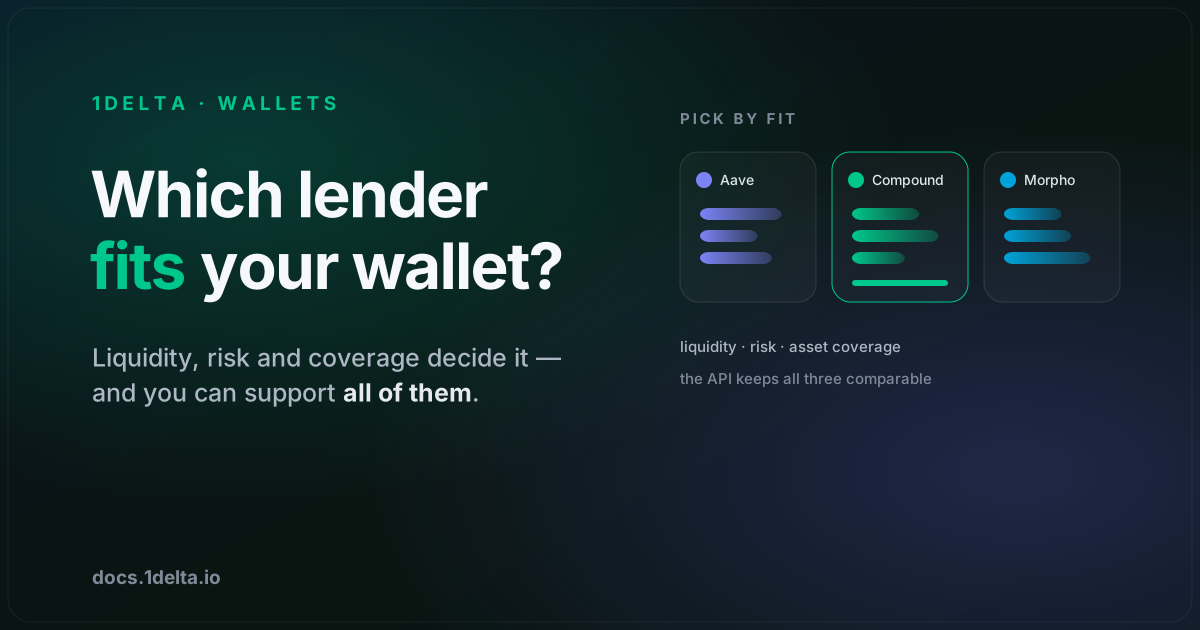
If Aave offers 5.2% on USDC, Morpho offers 7.8%, and Compound offers 5.8%, your users ask a simple question: where should I deploy capital?
Protocol choice determines yield, risk exposure, withdrawal reliability, and market coverage.
This guide explains how wallet teams decide which lending protocols to support, how to filter markets, and how to avoid multi-protocol integration overhead by using a unified API.
TLDR
- Wallets must balance yield, liquidity depth, risk models, and chain coverage
- Aave is baseline for liquidity and breadth
- Morpho is rate leader but requires vault-level risk decisions
- Compound is the stable middle ground with predictable markets
- Supporting 2 protocols at launch is usually enough
- Proper market filtering (TVL, utilization, chain context) matters as much as protocol choice
Why Protocol Selection Matters
The choice of protocol affects four decision criteria:
- Yield dispersion
- Protocols price risk differently. Rates shift by protocol and by chain.
- Example: Same stablecoin yields vary because protocol mechanics and liquidity balance differ.
- Risk model and liquidation mechanics
- Aave settles risk parameters via governance with global risk settings.
- Morpho Blue uses vault curators for isolated markets.
- Compound uses algorithmic interest rate curves and market-level collateral factors.
- Liquidation mechanics (thresholds, health factor behavior) impact withdrawal reliability.
- Liquidity depth and utilization behaviour
- Aave pools support larger withdrawals with less price slippage.
- Morpho vaults may have higher rates but lower liquidity per vault.
- Compound markets have steadier utilization curves.
- Chain coverage and market availability
- Not every protocol supports every asset on every chain.
- Multi-chain support determines where yield can actually materialize.
Wallets must understand that yield is not a single number. Yield is a distribution shaped by liquidity depth, utilization, and protocol mechanics.
Protocol-by-Protocol Decision Insights
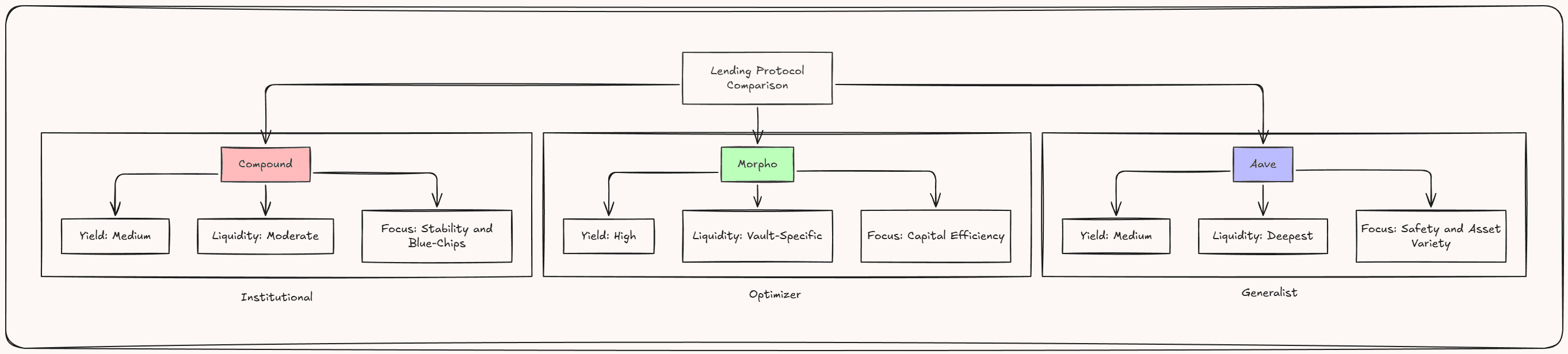
Aave: Liquidity Depth and Breadth
When it wins
- Deepest markets across stablecoins and blue chips
- Largest multi-chain deployment with conservative risk parameters
- Best for large deposits and withdrawal reliability
- Strong on assets with high TVL and low volatility
Where it lags
- Often lower yields due to pooled liquidity
- Average rate can underperform optimized venues (Morpho)
Key signals
- High TVL, consistent utilization below 80%, large deposit corridors
- User base demands safety and predictable exits
Decision logic
- If stability and coverage matter more than rate, support Aave first.
Morpho: Rate Leader, Complexity Trade-Off
When it wins
- Peer-to-peer matching pushes lender returns closer to borrower demand
- Often highest yields on major assets (stablecoins and ETH)
Structural differences from Aave
- Isolated vault markets have risk profiles per vault
- Curator reputation and collateral type matter
- Yield can diverge rapidly between vaults
Where it lags
- Liquidity fragmentation across vaults
- More risk decisions at curation layer
- Less battle testing historically than Aave
Key signals
- Users are rate sensitive
- Portfolio sizes where a few percentage points matter ($10K+)
- Users familiar with vault mechanisms (DeFi power users)
Decision logic
- If yield optimization is key and users tolerate complexity, add Morpho.
Compound: Predictable Middle Ground
When it wins
- Algorithmic rate markets with transparent curves
- Often sits between Aave and Morpho on yield
- Strong governance pedigree and market simplicity
- Compound v3 markets (Comet) simplify position accounting
Where it lags
- Smaller asset selection than Aave
- Liquidity depth usually lower than Aave
- Yields often lower than Morpho
Key signals
- Users who care about governance participation or predictable rate structure
- Markets where Compound's rate model is competitive
- Need for stable middle option in comparisons
Decision logic
- If you need a stable protocol with predictable behavior and governance appeal, include Compound.
Decision Framework: Which Protocols and Markets to Support?
Protocols
Wallet teams should avoid overwhelming users and engineering complexity by launching 5+ protocols at once. A crisp, defensible starting point:
- Baseline protocol: Aave (liquidity, coverage, trust)
- Rate optimization protocol: Morpho (higher yields)
- Optional third: Compound (governance and predictability)
You can later add emergent ecosystems like Spark on specific chains, Venus for BNB Chain, Radiant for cross-chain features, or Euler for long-tail assets once core demand stabilizes.
Markets
Let's say, you've picked the protocol. Now, which markets deserve wallet integration?
- Asset quality filter: Start with blue chips: USDC, USDT, DAI, ETH, WETH, WBTC
- TVL threshold: Markets with >$10M TVL are usually safer
- Utilization monitor: Avoid markets above ~85% utilization for new deposits
- Yield sustainability check: Unsustainably high APY relative to peer markets often signals incentives or temporary imbalances
- Collateral quality and oracle risk: For vault-driven systems (Morpho Blue), curate based on curator reputation and underlying collateral stability
These filters should populate your default product surface. A protocol may be supported, but only certain markets within it make product sense.
With our unified API, you support as many protocols and markets your users want.
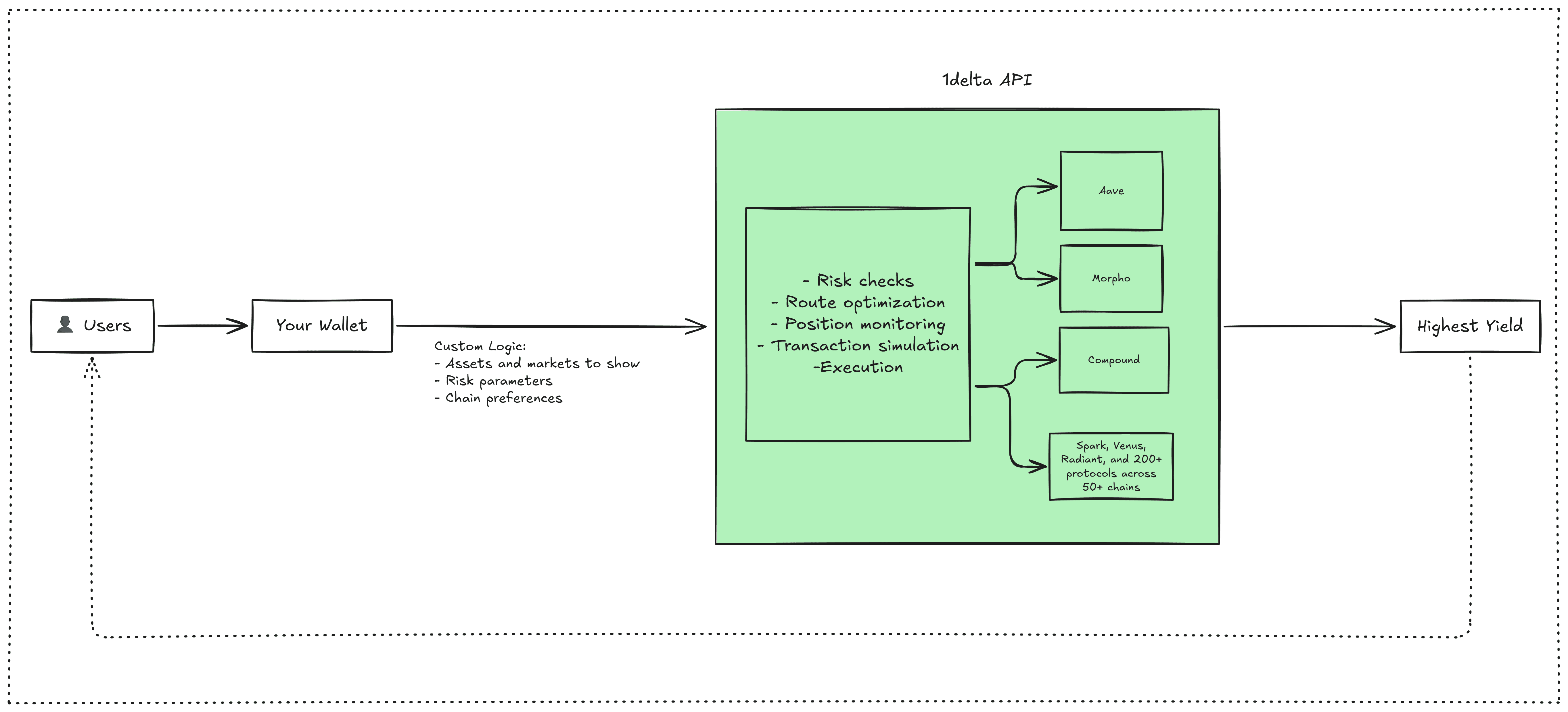
- instant multi-protocol support across 200+ protocols
- routing logic built in
- standardized execution and position tracking
- market filtering primitives and risk signals
Integrating 1delta API can unlock depth without multiplying engineering surface area.
Start Shipping
Choose protocols based on what your users actually need:
- yield optimizers = Morpho
- safety and liquidity depth = Aave
- predictable, governance-oriented markets = Compound
Support only a few protocols at launch and expand selectively based on demand signals and usage data.
To explore integration or access, reach out to the 1delta team.
Docs: docs.1delta.io
Contact: Telegram | [email protected]