The graveyard of undead lending forks
A lending market keeps running after its team leaves: interest accrues, deposits are accepted and aggregators still list the APR. Colend's oracle has been unfed since September, Avalon prices a sub-cent stablecoin at $1, Klaybank lends out bridge tokens from a 2023 hack, and a set of dead forks still answer to one key. What goes wrong, and what to check before supplying.

A lending market keeps running after its team leaves. Interest accrues every block, the pool accepts deposits, and aggregators list whatever APR the rate curve produces. What stops is the work a person has to do: pushing prices, liquidating bad positions, freezing a reserve when its collateral dies.
An abandoned Uniswap fork ages better. Its pools need no prices from outside: each trade sets the price, arbitrageurs keep it in line with the market, and a liquidity provider can withdraw at any time. A lending pool depends on decisions someone has to keep making: which oracle prices each asset, which collateral to accept and at what loan-to-value, when to freeze a reserve whose collateral has failed. When those decisions stop, the pool goes on running on the last ones made.
None of the markets below was drained by an attacker this year, and all of them are still live. Figures are as of 25 November 2026.
| market | chain | what is wrong |
|---|---|---|
| Colend | Core | every price read reverts since 21 Sep; USDC lenders owed $314k, pool holds none |
| Avalon USDX | BNB Chain | USDX priced at a constant $1.00, trades at $0.0065; $69M posted as collateral |
| Klaybank | Kaia | lends out bridge tokens from the 2023 Orbit hack at 101–105% utilisation |
| Radiant v2 | Ethereum | sunset announced in June; deposits still open; WETH reserve has no cash |
| seven ghost forks | BNB, Base, Linea, Sei and others | admin is one private key, no timelock |
Colend: an oracle nobody feeds
Colend is an Aave V3 fork on Core that peaked at $276M in November 2024. Today it holds about $680k of deposits.
Its oracle reads Pyth, a pull oracle: prices reach the chain only when someone submits a signed update, and Colend rejects any price older than 60 seconds. The market works only while someone can post prices ahead of each action.
On Core, updates arrived through Pyth's original Wormhole-signed path, which Pyth has since discontinued. The last price landed on 21 September 2026, posted by a bot that liquidated a 50-cent position in the same transaction. Nobody can post one now, so every price read reverts and the pool runs at half function:
- Still works: supply, repay, and withdraw for accounts without debt.
- Reverts: every borrow, every withdrawal by a borrower, every liquidation.
No liquidator can supply the missing price either. Since September CORE has fallen from $0.022 to $0.0099, and loans backed by CORE have lost more than half their collateral with nothing able to close them.
| reserve | supplied | borrowed | cash | utilisation |
|---|---|---|---|---|
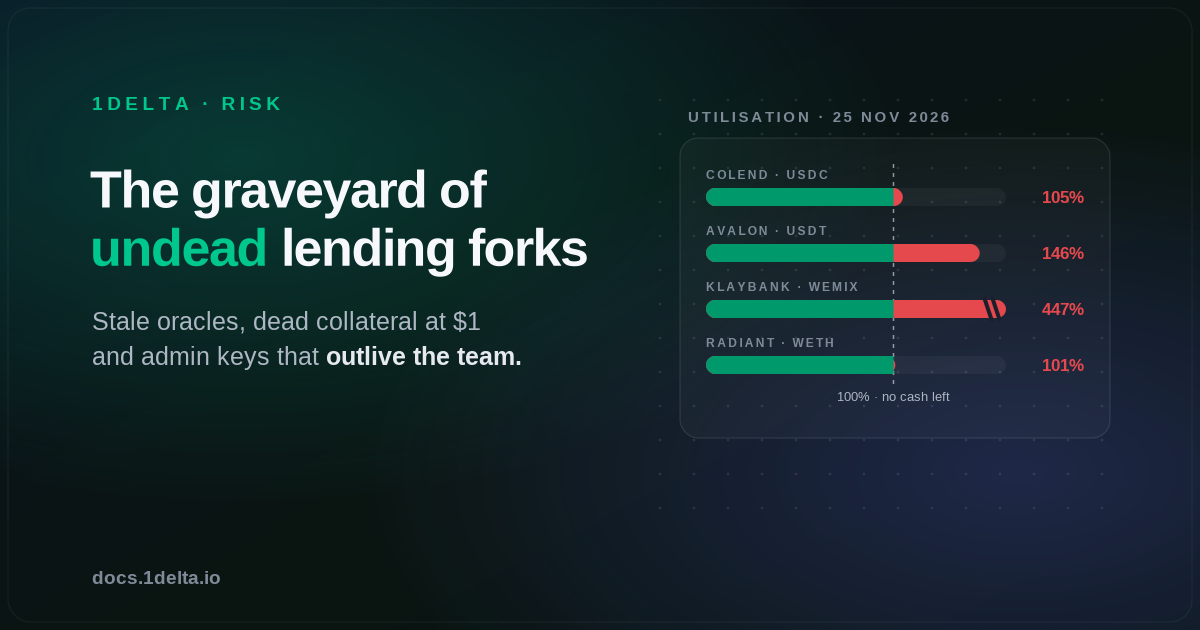
| USDC | 314,341 | 330,171 | 0 | 105% |
| USDT | 278,512 | 220,198 | 61,961 | 79% |
| WCORE | 5,102,679 | 2,106,629 | 3,007,916 | 41% |
USDC lenders are owed 314k and the pool holds nothing. With liquidations stuck, they are paid only if a borrower chooses to repay.
The configuration has shortcuts too. Colend's own token, CLND, is priced with the CORE feed, and six Bitcoin wrappers share one BTC/USD feed, so a wrapper that lost its backing would still be valued as bitcoin. The admin is a 2-of-3 Safe with no timelock. Two signers could repoint the oracle in one transaction. In nine weeks they have not.
Avalon USDX: a price that cannot move
Avalon runs an isolated market on BNB Chain for Stables Labs' USDX and sUSDX: post either at 80% loan-to-value, borrow USDT or USDC. All four assets are priced by one tiny contract that returns 100000000 from storage and has no setter. Every asset in the market is worth exactly $1.00.
USDX lost its peg in early November 2025, falling to $0.04 in five days after wallets that Beosin links to founder Flex Yang borrowed against it on Euler, Silo and Lista. It trades at $0.0065 today.
| reserve | supplied | borrowed | oracle price |
|---|---|---|---|
| sUSDX | 49,004,414 | 0 | $1.00 |
| USDX | 20,000,104 | 1 | $1.00 |
| USDT | 14 | 21 | $1.00 |
| USDC | 119 | 160 | $1.00 |
The pool is paused, and it has to stay that way: unpaused, anyone could buy USDX below a cent and borrow 80 cents against it. Lenders lost little, because the loan side never held more than a few hundred dollars. What remains is $69M of collateral valued about 150 times too high, which any tool using the pool's own oracle reports as real. The 3-of-5 Safe that runs the market paused it and left the $1 source in place for a year.
Klaybank: the oracle works, the assets do not
Klaybank, an Aave V2 fork on Kaia, peaked at $134.5M in 2022. Most of its reserves are tokens bridged through Orbit Bridge, which lost $81.5M on 31 December 2023. Its oracle tracks them correctly: oUSDT at $0.105, oETH at $117.
| reserve | supplied | borrowed | utilisation | borrow APR |
|---|---|---|---|---|
| oUSDT | 737,629 | 744,787 | 101% | 64% |
| oUSDC | 225,666 | 236,601 | 105% | 79% |
| WKLAY | 1,172,459 | 1,182,270 | 101% | 108% |
| WEMIX | 12,106 | 54,156 | 447% | 791% |
Every large reserve is fully lent, so no lender can withdraw, and debt compounds at the top of each rate curve. Borrowers who posted oUSDT at a dollar owe against it at ten cents and have no reason to repay. The admin is a single key.
Radiant: a sunset that left the door open
Radiant lost about $50M in an October 2024 key compromise and announced its sunset on 1 June 2026: emissions stopped, borrow caps cut to one token, contracts left online for withdrawals and repayments.
On Ethereum the WETH reserve has 32.4 WETH supplied, 32.8 borrowed and no cash, at a 110% borrow rate. The oracle and liquidations still work, so this one should clear. The gap is that no reserve is frozen: deposits are still accepted, and WETH sent today by a script or an aggregator joins a queue of lenders with nothing to withdraw.
Ghost forks
Seven small Compound V2 and Aave forks in our data (Demeter, Lander, Xpert, lendOS, Mooncake, Paxo, Kawa) launched, found few users and were left running. Their balances range from $45 to about $10k. Each is controlled by a single private key with no timelock, which can replace the oracle, change collateral factors and list markets in one transaction.
Ploutos showed what that key can do. In February 2026 its USDC oracle was pointed at a BTC/USD feed one block before $390k was borrowed out, and the team's site and socials disappeared the same day.
Patterns
Oracles. The cases above fail in four different ways:
- The update path that went away. A pull oracle depends on a delivery route its provider can retire. When Pyth discontinued the route Colend uses, prices froze, and the staleness check stopped liquidations with them. Only the admin can move the market to a new source (Colend).
- The constant. A fixed $1 is defensible while the issuer redeems at par and needs replacing the day it stops (Avalon).
- The right price for a dead asset. An accurate oracle cannot make borrowers repay debt worth more than its collateral (Klaybank).
- The swappable oracle. Whoever can set the source can set the price (Ploutos).
Governance. An abandoned market keeps an owner with every power it had at launch. One key with no timelock can change anything in a block. A small multisig survives a lost key but still needs signers who show up. A wind-down that caps borrowing but leaves deposits open keeps taking in new lenders. A timelock adds little when nobody is watching the queue.
Utilisation above 100%. Borrowers pay the full rate while lenders earn it minus the reserve factor. Once cash hits zero and nobody touches the reserve, debt outgrows deposits. A reading above 100% means the reserve has been empty for a while. Its supply APR sits at the top of the curve, so these markets rank first in any yield list sorted by rate, and the yield cannot be withdrawn.
What to check before supplying
- Cash against your deposit. At 100% utilisation you cannot get out until someone repays.
- Whether the oracle answers. Call
getAssetPricefor each asset. A revert means no borrowing and no liquidations. - Who the admin is. One key without a timelock decides the price of your collateral.
- When the reserve last moved. A stablecoin reserve untouched for two months has no active users.
- The collateral's price elsewhere. If the pool and the market disagree, believe the market.
1delta's risk data rates Radiant and the ghost forks 6 (defunct), Avalon USDX and Ploutos 7 (compromised), and Klaybank and Colend's USDC market 5. The 1delta API leaves scores of 5 and above out of its default results.
Sources: Contract reads on 25 November 2026: Colend Pool 0x0CEa9F0F49F30d376390e480ba32f903B43B19C5 (Core), Avalon USDX Pool 0x77fF9B0cdbb6039b9D42d92d7289110E6CCD3890 (BNB Chain), Klaybank LendingPool 0x4B6Ece52D0EF60aE054f45c45D6bA4F7a0C2cC67 (Kaia), Radiant v2 provider 0x70e507f1d20AeC229F435cd1EcaC6A7200119B9F (Ethereum). Prices and TVL from DefiLlama. USDX depeg: The Block, Beosin. Orbit Bridge: CoinDesk. Radiant: The Block. Colend oracle design: docs.