How Decimal Integrated DeFi Lending With One API
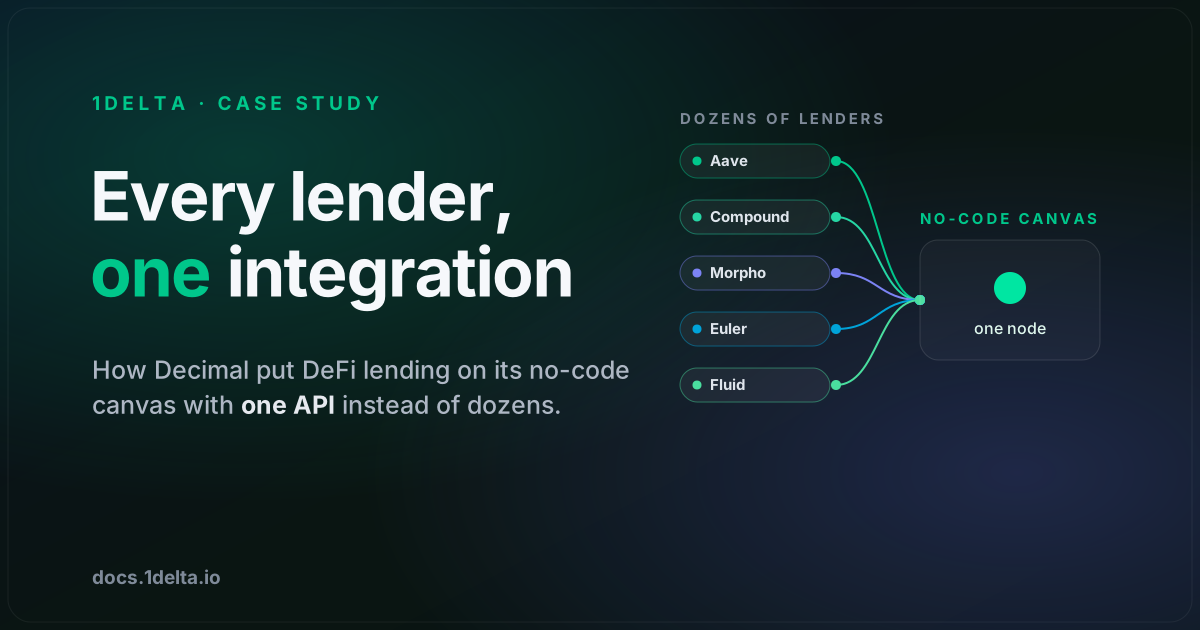
Decimal lets users automate Web3 through drag-and-drop workflows. Instead of building a separate lending integration for every protocol and chain, it integrated 1delta once, unlocking hundreds of markets and cutting weeks of development and ongoing maintenance.
At a Glance
- Partner: Decimal, a no-code Web3 automation platform with 100+ integrations across Ethereum, Arbitrum, Polygon, Base, and other networks.
- Challenge: Add lending markets to a drag-and-drop canvas without building and continuously maintaining a separate adapter for every protocol and chain.
- Approach: Integrate the 1delta API as a single workflow node, providing one normalized REST interface across roughly 3,000 lending markets.
- Result: One integration gave Decimal access to 100+ lenders supported by 1delta across the six chains currently available through the 1delta API, replacing dozens of separate protocol-and-chain integrations and their ongoing maintenance.
- Their report: An excellent developer experience, backed by hands-on collaboration from 1delta's team through testing, edge cases, and output-shape tweaks.
- Timeframe: 10–14 days of development, followed by two weeks of testing.
The Challenge
Decimal's product is a visual workflow builder: a non-developer connects a trigger to a chain of actions, such as a price alert, a recurring swap, or a treasury rebalance, and lets it run, with no Solidity and without operating their own backend. The platform's value is the breadth of blocks on that canvas.
Lending is where that breadth gets expensive. "Move my idle USDC to the best deposit rate" sounds like one workflow step. Underneath, it's a fragmentation problem: dozens of lenders, each with its own contracts, its own rate encoding, and its own definition of a position, multiplied across every chain. To put lending on a drag-and-drop canvas, Decimal needed all of that to collapse into one clean building block a non-developer could drop in and trust.
The real obstacle was maintenance, not the first version. Hand-rolling lenders is never done: every protocol becomes a node to document and keep alive as those protocols ship breaking changes, and the moment one does (Aave's V3.2 re-encoding of eModes mid-life is a real example), every workflow built on the old shape silently breaks. For a platform whose promise is "set it and forget it," a data layer that quietly drifts is the worst kind of liability.
The Approach
Decimal integrated the 1delta API as that single building block. From the platform's perspective, it is one normalized surface over plain HTTPS with a single x-api-key header, with no nodes to run and no ABIs to track. Two endpoint families cover most of what a lending workflow needs:
| Endpoint | What it returns |
|---|---|
/v1/data/lending/pools · /lending/latest | Every market on a chain - depositRate, variableBorrowRate, totalLiquidityUsd, collateral/borrow flags, and a stable marketUid like AAVE_V3:42161:0x… |
/v1/data/lending/user-positions | A wallet's positions across every indexed lender - per-token deposits and debt in USD, plus a per-lender health factor |
The decisive property: every record comes back in the same shape, regardless of the underlying protocol. An Aave pool, a Compound V3 Comet market, a Morpho Blue market, and a Silo vault all surface as the same pool object and the same position object. Even three generations of the same protocol are normalized into one consistent schema, as shown in our article on unifying Aave. So a workflow node can render a rate or read a health factor without protocol-specific branching logic.
Two properties of that surface directly answer the challenge:
- The hard parts live behind the API. Encoding
eth_callrequests across a dozen ABIs, decoding fixed-point rate formats, scaling raw balances by token decimals, and fetching oracle prices for USD values were all handled outside Decimal's codebase. That is why the integration was straightforward: parse one pool object and you've parsed them all, and a normalized REST response (inputs → request → typed outputs) already matches the shape of a no-code block. In Decimal's words, "the documentation got us up and running quickly." - Maintenance is upstream. When a protocol ships a breaking change, the normalization absorbs it on the API side; the node and the workflows on top of it don't need to change. The standing liability that made the build-it-yourself path expensive simply isn't Decimal's to carry, which is a major source of the time saved.
The Results
Decimal summed up the integration in its own words:
The developer experience with 1delta was excellent. The documentation got us up and running quickly, but what really stood out was the team's willingness to collaborate. They helped us validate our integration during testing, were responsive whenever we ran into edge cases, and even accommodated changes to the output structure to better align with Decimal's automation engine. It's rare to see that level of technical support from an infrastructure team. — Abhijat, CEO and Founder, Decimal
Concretely, that breaks down into the work that didn't have to be built. Each row represents work that a from-scratch integration requires upfront and continues to require over time.
| Work the API absorbs | Building it yourself |
|---|---|
| Protocol adapters | A bespoke integration per lender, then again per chain |
| Rate normalization | Converting each protocol's fixed-point rate encoding into one comparable APR |
| Amount scaling | Scaling raw balances by token decimals and converting them into USD values |
| Positions & health | Re-deriving each lender's account data and health-factor definition into one shape |
| Ongoing maintenance | Tracking breaking changes, such as Aave V3.2 re-encoding eModes mid-life, so workflows don't silently break |
That last row is the one that compounds. A hand-rolled integration is a standing liability that grows with every protocol and every upgrade; a normalized dependency is kept current upstream, so the next supported chain or lender can become available without Decimal building another protocol-specific adapter.
The scale behind "one node" makes the trade concrete. Across the six chains, the pools API exposes 121 lenders (each requiring protocol- and chain-specific integration work), and those lenders fan out to roughly 3,000 individual markets:
| Chain | Lenders covered | Markets covered |
|---|---|---|
| Ethereum | 44 | 1,708 |
| Base | 25 | 570 |
| Arbitrum | 25 | 399 |
| Optimism | 14 | 18 |
| Avalanche | 8 | 308 |
| Gnosis | 5 | 4 |
| Total | 121 | ~3,000 |
The leverage comes from exposing thousands of markets through one normalized integration. Market counts vary significantly across protocols and deployments. Building in-house, Decimal would have written and maintained all 121 lender integrations to reach ~3,000 markets, re-deriving each protocol's rate math, decimals, and health-factor definition along the way. Through the node, that coverage becomes available in a single dropdown.
The read block is the only one that touches DeFi data, and it speaks to one API. The condition compares APYs that are already in the same unit; the action moves funds to the selected marketUid without caring whether it's an Aave market on Base or a Morpho market on Arbitrum. What would otherwise take months of adapter development shows up as one reusable node with a dropdown.
Why It Worked
Decimal's value is the canvas: the triggers, conditions, no-code ergonomics, and multi-chain execution. Normalized lending data across multiple protocols is essential underneath that, but it is not where Decimal wins or loses. It is undifferentiated infrastructure that every product needs in essentially the same form.
It helped that the data layer came with a team, not just an endpoint. 1delta validated the integration during testing, turned around edge cases quickly, and adjusted the output structure to fit Decimal's automation engine. That is the kind of hands-on support that turns a dependency into a partnership.
That is the transferable lesson. If lending data is necessary for your product but not part of your competitive advantage, a normalized API removes both the initial integration work and the maintenance burden that follows. The immediate benefit is one consistent schema and one authentication layer. The longer-term benefit is every adapter, rate conversion, and breaking protocol change that never reaches your backlog.
Where to Go Next
- ** Decimal:** Explore the no-code Web3 automation platform featured in this case study.
- ** API reference:** Review the
/v1/data/lending/*endpoints andx-api-keysetup used by Decimal. Start with/lending/pools. - 1delta docs: Explore the 121 supported lenders, network coverage, and the rest of the lending API documentation.